

👉 👉 Start your day the dharmic way
Small steps today — real change tomorrow.
A dharmic routine is not a sequence of pious gestures; it is an architecture of attention — tiny, repeatable choices that align daily action with a larger purpose (svadharma), reduce reactive living (nishkama karma), and cultivate non-harming (ahimsa) toward self and others. Think of it as designing your morning to conserve willpower, sharpen focus, and grow moral muscle. Over time, those conserved decisions add up to a life that feels right and does right.
📑 Table of Contents
- 👉 👉 Start your day the dharmic way
- 👉 Part I — Foundations: Mindset + Minimal Structure
- 👉 Part II — Morning Rituals (Core) — 15–60 minutes
- 🌟 A. 15-minute Minimal Routine (for busy people)
- 🌟 B. 30–60 minute Expanded Routine (for deeper practice)
- 👉 Quick 21-day starter plan
- 👉 👉 Part III — Workday Habits — Keep Dharma in Action
- 👉 👉 Part IV — Evening Integration & Reflection
- 👉 👉 Conclusion — People, Planet & Profit + 21-Day Starter Plan
- 🌟 A. Synthesis: three core promises of a dharmic routine
- 🌟 B. People, Planet & Profit (short practical tie-ins)
- 🌟 C. 21-Day Starter Plan (daily template — copy/paste version)
- Practical FAQs
- 📌 Related Posts
This short guide gives you a practical, science-friendly template to test for 21 days. You’ll receive a 15–60 minute morning blueprint, exact scripts to begin each habit, habit-stack formulas, and fast troubleshooting for the friction points that derail most good intentions. The promise: by the end of this section you can pick one habit from Part II and one micro-practice from Part I or III, try them tomorrow, and measure the difference in one week.
If you publish these micro-commitments publicly — a comment, a morning message to a friend, or a single check in a habit tracker — you dramatically increase your chance of follow-through. That’s the micro-accountability we’ll use: a visible token, a short script, and a method that fits a busy schedule.
A practical note: this approach sits at the intersection of ancient ethical frames and modern habit science — it’s inspired by Dharmic aims but built in the language of cue → routine → reward (behavioral sequencing).
Micro-commitment (do this tonight): choose one core habit from Part II and one micro-practice from Part I. Put a physical token (a small stone, sticky note, or jar) by your bed. Tomorrow, do them. Report back.
👉 Part I — Foundations: Mindset + Minimal Structure
Goal: set the inner scaffolding so rituals stick. A dharmic routine fails fast if the mind’s scaffolding is flimsy; build three pillars — belief, structure, and repair — and the rest becomes practical.
🌟 1. Core beliefs (micro-manifesto)
Write these three lines and keep them where you can see them. Say them aloud once daily for seven days; the neural patterning makes decisions easier.
- “I act more than I react.”
- “My day’s first acts shape the rest.”
- “I choose practice over perfection.”
Why these? Neuroscience shows that early-morning choices bias later decisions (decision fatigue research). A short, repeated mantra converts abstract ethics into concrete neurological anchors — a micro-manifesto.
🌟 2. Three non-negotiables (shortlist)
Keep the routine tiny but holy — three short, guaranteed actions:
- Anchor (1–3 min): a breath practice or a prayer to center attention.
- Intention (30–60 sec): speak a one-line svadharma for the day.
- Micro-accountability (10 sec): mark a token (stone in a jar, check on app) when done.
These three non-negotiables are the scaffolding. They consume negligible time but create a ritual loop: cue → action → visible completion.
🌟 3. The 3-minute rule (behavioral hack)
If a habit takes ≤3 minutes, it becomes nearly impossible to skip. Use this rule to bootstrap consistency: 3 breaths, 1 sentence intention, a 1-minute stretch. Behavioral science calls this the tiny habit principle: once the motion exists, expansion is easier.
Practical micro-habits to start:
- 3 diaphragmatic breaths sitting on the bed.
- One-line intention aloud.
- One-minute wrist/neck rotation.
🌟 4. Habit stacking formula (clear pattern)
Use the formula: After [existing habit], I will [new micro-habit]. This leverages an already-stable cue.
Examples of effective stacks (adapt these; keep the pattern):
- After I turn off my alarm, I will sit upright and breathe 3 times.
- After I wash my face, I will speak my one-line intention.
(These are patterns you will reuse across Part II; keep your stacks consistent so memory binds the routine.)
🌟 5. Quick scripts (use these exact lines)
Words matter. Say these exactly; words anchor cognition and shape behavior.
- Morning intention: “Today I will do my duty with attention and kindness.”
- Micro-compassion: “Mistakes are data, not identity.”
- If rushed: “This moment is enough.”
Use the exact phrasing for the first 21 days; precise language helps form stable neural pathways.
🌟 6. Troubleshooting: common failure modes & fixes
I snooze.
Fix: Move phone out of reach. Set a single non-negotiable: 3 breaths must be done before bed or you don’t sleep. (Concrete rule reduces negotiation at dawn.)
I forget.
Fix: Attach to a keystone routine (brush teeth → 3 breaths). Use a physical cue (stone on bedside table).
I feel guilty when I miss.
Fix: Replace guilt with curiosity. Ask, “What stopped me?” Plan one tiny change for tomorrow. Guilt lowers next-day motivation; curiosity increases it.
My environment is chaotic.
Fix: Build a 30-second environment prep at night — a jar, a stone, a cup for water. The pre-made environment reduces friction.
I’m too tired.
Fix: Swap to a 1-minute anchor (3 breaths + intention). Consistency trumps duration.
🌟 7. Quick checklist to copy (paste-friendly)
- Anchor ✓
- Intention ✓
- One micro-practice ✓
- Token placed ✓
Copy this into your notes or habit app. Check it each morning.
🌟 8. Short scripts for partners & accountability
If you want social accountability, use a one-line message to your accountability buddy:
- “Did my 3 breaths + intention. One stone in the jar. Day X.”
Short, factual, replicable messages work better than long confessions.
👉 Part II — Morning Rituals (Core) — 15–60 minutes
Goal: begin the day with grounding and clarity. Choose a routine that fits your life — Minimal (15 minutes) for busy days, Expanded (30–60 minutes) for deeper practice. Both are dharmic because both support svadharma: acting with purpose.
🌟 A. 15-minute Minimal Routine (for busy people)
A compact routine that uses the 3-minute rule and habit stacking to produce a meaningful start.
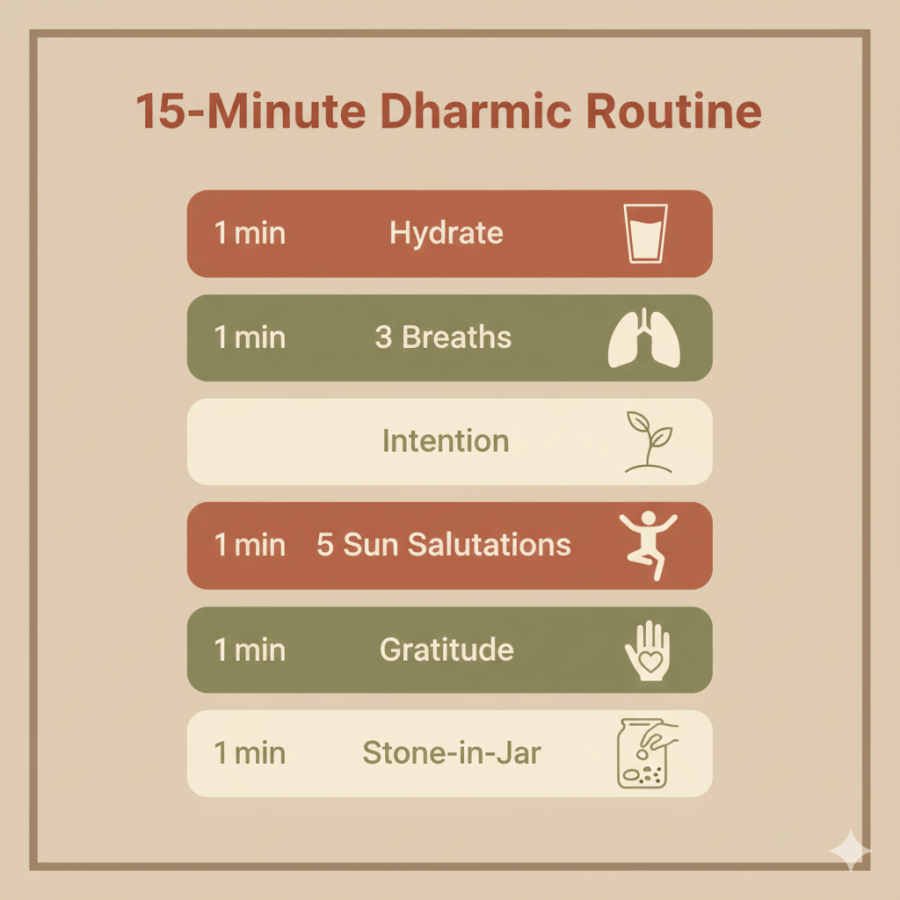
Total time: 15 minutes
- Wake & hydrate — 1 minute
Drink one glass of water. Hydration resets brain chemistry and signals the body that the day has begun. - Anchor breathing — 2 minutes
Three rounds of box breath (4-4-4-4): inhale 4, hold 4, exhale 4, hold 4. Repeat three times. Script to use exactly: “This breath is my anchor.” - Intention statement — 30 seconds
Speak aloud one sentence svadharma. Exact phrasing option: “Today I will act from purpose, not panic.” - Body quicken — 5–7 minutes
Either five sun salutations (if familiar) or a 2-minute full-body stretch: neck circles, shoulder rolls, forward fold to hamstring stretch, gentle squats. - Gratitude / Offer — 30 seconds
Name one thing you offer today. Say aloud: “I offer this work for the well-being of many.” - Visual cue — 30 seconds
Place a small stone in a jar (or tick a checkbox). This physical token closes the loop and creates visible progress.
Why this works: hydration primes physiology; breath reduces sympathetic arousal; intention frames attention; movement wakes the nervous system; gratitude reframes reward circuits; token creates tangible reward.
🌟 B. 30–60 minute Expanded Routine (for deeper practice)
For those who can spare more time — or want to deepen practice on key days.
🔗 Read More from This Category
Total time: 30–60 minutes
- Water + gentle movement — 5 minutes
Start with a glass of water and a slow 3–5 minute mobility flow: cat-cow, hip openers, gentle twists. - 10-minute seated practice — 10 minutes
A seated breath-and-mantra combination. Breathwork (5 min) followed by a short mantra or scripture line (5 min). Use a concise mantra like, “I act, I don’t clutch.” (Say it silently or softly). Combine with a 4:6 exhale ratio to promote parasympathetic tone. - 10–15 minute reflective journaling — 10–15 minutes
Three prompts — write fast, in bullet form:- What is my duty today?
- What’s within my control?
- How will I be kind to myself?
This short reflective practice creates a cognitive map for the day and reduces rumination by externalizing worry.
- Short reading — 5–10 minutes
Read one stotra, aphorism, or short verse and write one practical line of application beneath it. - Plan a single, highest-impact task (HIT) — 2 minutes
Identify one box to finish by noon. This is your morning keystone task. Treat it as non-negotiable.
Why expanded works: longer practices strengthen attention systems, journaling scaffolds cognitive control, and the HIT reduces decision load later.
🌟 C. Scripts & micro-phrases (use these exactly)
Use the following exact lines to seed neural anchoring during the first 21 days:
- On breath: “This breath is my anchor.”
- Intention seed: “Today I will act from purpose, not panic.”
- Offer line: “I offer this work for the well-being of many.”
Repeat them aloud or silently to mark transitions — they act like bookmarks for attention.
🌟 D. Habit stacking examples
Use simple stacks to fuse rituals into life:
- After I water my plants, I will do 3 box breaths.
- After I make tea, I will write my HIT for the day.
- After I close my bedroom door, I will place one stone in the jar.
These create predictable sequences with minimal decision friction.
🌟 E. Quick tactics to maintain routine
- Visual accountability: put the token jar somewhere visible (kitchen shelf, desk). Visual cues cue behavior.
- Pairing: practice with a friend via morning text or a 7-day challenge group. Micro-commitments thrive on social proof.
- Micro-reward: allow a single sip of your favorite tea only after completion. Small rewards reinforce habit loops without derailing discipline.
- Night prep: set out the stone, a filled glass, and the journal page. The environment predicts behavior.
🌟 F. Short troubleshooting
Missed morning? Do a one-minute reset at lunchtime: 3 breaths + reframe + write the HIT for the afternoon. This salvage routine recovers momentum and prevents a single miss from spiraling.
Too busy to journal? Make a one-line journal: HIT by noon // One way I will be kind: … — 10 seconds.
Can’t settle for seated practice? Do walking breath: inhale 3 steps, exhale 3 steps — repeat 6 times.
👉 Practical science: why these elements matter
To keep this part short and evidence-grounded: these practices draw on three research-backed mechanisms.
- Attentional framing: Intention-setting restructures executive attention, reducing mind-wandering and improving task priority selection. Short, focused journaling primes prefrontal networks for sustained work.
- Stress modulation: Breathwork (box breaths) activates the vagus nerve and downregulates amygdala reactivity. Even three rounds reduce cortisol spikes and improve decision quality the rest of the morning.
- Reward & reinforcement: Physical tokens (stone in jar) and micro-rewards establish immediate reinforcement that bridges the gap between action and delayed intrinsic reward (meaning). Short habits plus visible progress increase habit persistence by creating salience.
👉 Quick 21-day starter plan
This 21-day plan increases practice gradually and keeps friction low.
Days 1–3 (Build the scaffold): Anchor (3 breaths) + Intention (one line) + Stone-in-jar. (Total 3–4 minutes)
Days 4–7 (Add movement): Add 2-minute stretch or 5 sun salutations. Write one HIT (2 minutes). (Total 8–12 minutes)
Days 8–14 (Deepen): Add 10-minute seated practice or short journaling session (10 minutes). Continue stones. (Total 20–30 minutes on practice days)
Days 15–21 (Stabilize & refine): Choose minimal or expanded daily depending on schedule; maintain tokens. On day 21, reflect: What changed? What felt different? Keep the practice that produced the clearest benefit.
Daily tracker column headers (copy into sheet): Date | Anchor Done ✓ | Intention Done ✓ | Practice (15/30/60) | HIT completed by noon ✓ | Notes (energy, mood, friction)
Be kind to inconsistency. True change is non-linear. Use curiosity instead of judgment.
👉 👉 Part III — Workday Habits — Keep Dharma in Action
Goal: make work decisions dharmic — purposeful, ethical, focused.
A dharmic morning without dharmic work habits is like a well-tuned instrument left idle. Part III turns your interior practice into reliable workplace behaviors: simple, repeatable protocols that reduce reactivity, increase clarity, and preserve moral bandwidth. Below you’ll find ready-to-copy scripts, meeting micro-rules, energy-mapping tools, micro-practices to reduce reactive harm, team compassion checks, tiny rituals for meaning, and practical troubleshooting. Use this as an operational manual for any workday — solo, remote, hybrid, or team-based.
👉 🌟 1. Morning lock-in (within the first hour)
Why this matters: The first hour after your morning practice is the day’s most fragile resource. It’s also the most leverageable: one focused block early prevents reactive firefighting later.
Action steps (copy/paste):
- Immediately after your morning routine: open a fresh document or a blank note and write one line: HIT (today): [single highest-impact task].
- Block 60–90 minutes on calendar labeled: HIT — Focus Block (No Notifications). Set status to “Do Not Disturb.”
- Start the block with a 30-second anchor breath and read your HIT aloud: “This is my chosen work for the day.”
Why it works: A clear HIT reduces decision fatigue (fewer micro-decisions) and creates momentum. Calendar blocking and visual labeling reroute interruptions and signal to collaborators that you’re in deep work.
👉 🌟 2. The 3-minute pause before decisions
Why this matters: Most harm at work happens in split-second replies — sharp emails, tone-deaf messages, impulsive escalations. A tiny, mechanical pause adds moral bandwidth.
Exact script to use before any outgoing message or decision:
- Breathe 3 times (inhale–pause–exhale; slow).
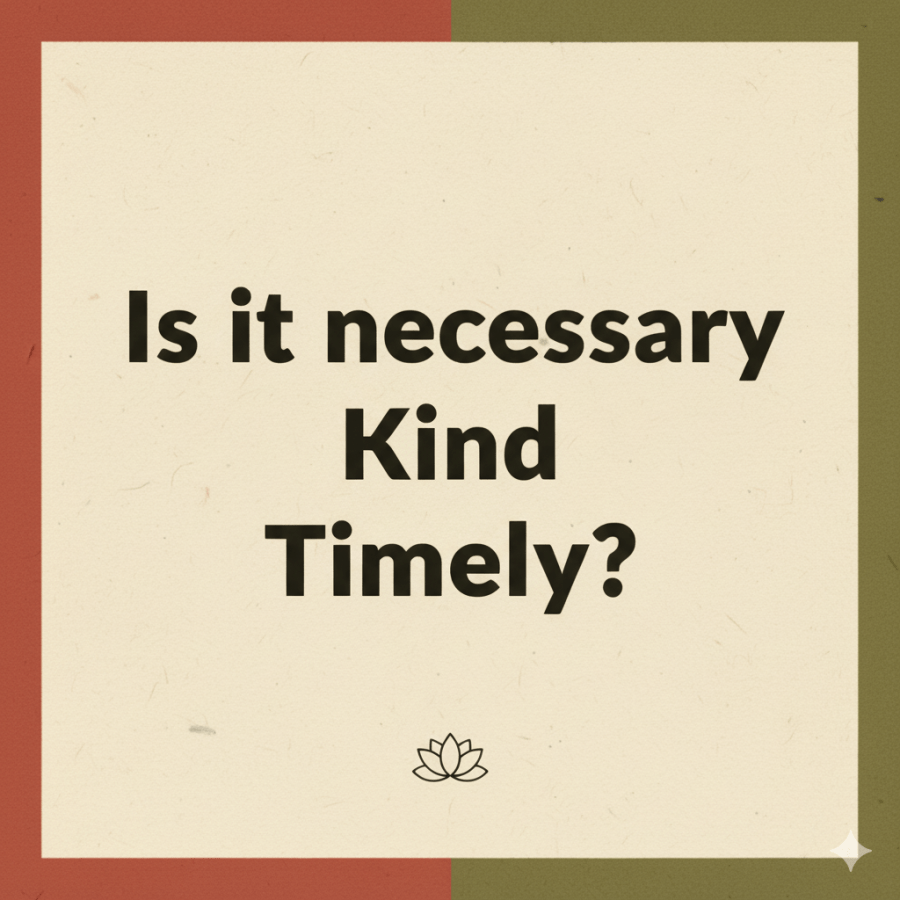
- Ask out loud: “Is this necessary, kind, and timely?”
Follow-up actions depending on the answer:
- If No to any: Do not send now. Save as draft or schedule for later.
- If Yes to all: proceed; after sending, mark the action in your daily log.
Micro-rationale: Friction helps. 3 slow breaths reduce sympathetic arousal; the triad necessary / kind / timely is a compact ethical filter that maps directly to svadharma (duty), ahimsa (non-harm), and situational wisdom.
👉 🌟 3. Meeting Dharma Protocol (micro-rules)
Why this matters: Meetings often waste attention and erode morale. Replace habitual meeting friction with a micro-protocol that centers purpose and learning.
Meeting micro-protocol (copyable):
🏷️ You Might Also Like (Similar Tags)
- Five Elements – Sanātana Dharma
- The Story of Cate: Embracing the Eternal Soul
- Ishvara in Sanatana Dharma: Unveiling the Concept of Supreme Divinity
- Varna-Sankara in Sanatana Dharma: Psychological Struggles, Modern Realities, and Practical Solutions
- Sanatana Dharma: The Introduction, History, and Significance of Sanatana Dharma
- Start (30 seconds): Host reads one-line intention: “Our intention for this meeting is [clear outcome]. We will decide [specific deliverable] today.”
- Speaking rule: When someone speaks, they speak for no more than 3 minutes. After their turn, others wait 30 seconds before responding — a brief reflective pause to process and avoid reactive rebuttals.
- Decision close: End with one concrete next step (owner + deadline) and one lesson learned. The host types the next step into the chat or meeting notes.
- Optional close ritual: ring a small bell or say aloud: “One task. One lesson.”
Templates to paste into calendar invites (one-liner):
“Meeting Dharma: Start with 30s intention. Each speaker ≤3 min. End with one next-step + one lesson. Bring empathy.”
Why it works: The time-boxed speaking rule prevents dominance; the reflective pause reduces escalation and groupthink; the lesson-steering creates learning loops. This micro-protocol can be trialed for two weeks and adjusted.
👉 🌟 4. Energy management (not time management)
Why this matters: Time is fungible; energy is finite. The dharmic approach schedules work to suit physiology rather than the calendar’s tyranny.
Actionable energy mapping (copy/paste):
- Week 1 — Energy audit (3 days): At 9am, 1pm, 4pm rate energy 1–5. Record what tasks you did.
- Create your energy map: identify two peak windows (90–120 minutes) and one low-energy window.
- Schedule accordingly: place creative/deep tasks in peak windows; admin, emails, and low cognitive tasks in low-energy windows.
Practical rule: Two-pomodoro then stretch — either 50/10 or 25/5, whichever matches your flow. After two pomodoros, stand for 2 minutes, stretch or walk, ring a small bell if you use one, and place the stone back in jar to signal block completion.
Why it works: Short focused bursts align with ultradian rhythms (cycles of high and low attentional capacity). The small break resets attention, prevents burnout, and maintains embodied alertness.
👉 🌟 5. Micro-practices to reduce reactivity
Why this matters: Reactive responses cost trust and create reputational debt. Preventing reactive behavior is both ethical and strategic.
Concrete micro-practices (copy/paste):
- Email batching: Check email twice daily — once mid-morning, once late-afternoon. Use an autoresponder outside those windows that says: “I check email at 11:00 and 16:30. If urgent, please mark urgent.”
- If provoked (script): “I’ll circle back after I reflect.” Then take a 60-second walk or 3× box breaths before replying.
- Draft-first rule: Before sending any reply that might escalate, save draft and re-open after 20–30 minutes. Edit for tone.
Why it works: Delay creates space. A neutral script buys time while signaling respect. Draft-first prevents the “send in anger” mistake.
👉 🌟 6. Compassion checks (for teams)
Why this matters: Teams are human ecosystems. Routine compassion prevents hidden strain and fosters psychological safety.
Simple team rituals (copy/paste):
- Weekly stand-up item: “Who needs help?” — 30 seconds for team members to raise a need.
- Restorative language template: “I could be wrong — tell me how you see it.” Use this when disagreeing.
- Gratitude feed: One quick appreciation in team chat daily: “Thanks @A for X.”
Why it works: A small culture of asking for help reduces hidden workload and distributes risk. Restorative language reduces ego-defense and models intellectual humility.
👉 🌟 7. Tiny rituals for meaning
Why this matters: Meaningful micro-rituals turn mundane work into service. They are inexpensive ways to connect inner purpose with outer tasks.
Tiny rituals (copy/paste):
- Midday offering: Send one small help to a colleague: a link, an intro, a kind note. Make it action-oriented: “Thought this might help — happy to connect you.”
- End-of-block ritual: At the end of your focus block, ring a small bell and place the stone back in the jar (or tilt it). This signals completion and closure.
Why it works: Rituals provide psychological punctuation. They help the brain consolidate effort and close cognitive loops — reducing stress at day’s end.
👉 🌟 8. Troubleshooting common work frictions
Overdrive / burnout:
- Fix: schedule a mandatory 20-minute offline window daily. Treat it as a non-negotiable. Put it on calendar: Offline — Rest & Reset.
Moral fatigue / decision heaviness:
- Fix: keep a short values memo (one paragraph) pinned in your notes. When the decisionload is heavy, read it. It acts as an ethical compass.
Constant interruptions:
- Fix: configure status messages and calendar blocks. Add a meeting tag: Dharma Focus so teammates learn to respect those periods.
Low team engagement:
- Fix: trial the Meeting Dharma Protocol for 2 weeks. Collect one metric: percentage of meetings that end with a clear next step.
👉 👉 Part IV — Evening Integration & Reflection
Goal: end well to start well; integrate learning and rest.
A good day deserves a tidy ending. The evening practice is not passive “wind-down”; it’s the last ethical act — a ritual of repair and integration that restores capacity for the next day. The following practices help you close the loop on work, relationships, and inner life.
👉 🌟 1. 10–15-minute Evening Routine (core)
Total time: 10–15 minutes. Copy/paste template:
- Tech cutoff — 60 minutes before bed. Put devices on Do Not Disturb and flip the screen away.
- Tidy for 3 minutes. Clear desk, stack documents, place your stone back in its jar. A tidy environment signals completion.
- Gratitude + lesson — 2 minutes. Write one line you’re grateful for and one lesson learned (two lines maximum). Example format: Gratitude: Today I’m grateful for X. Lesson: Next time I will Y.
- Letting-go ritual — 30 seconds. Say aloud: “I did my best; results belong to the world.” (Use the exact line for 21 days.)
- Sleep prep — 3 calming breaths in bed. Lie down, practice 3 slow breaths, and visualize one positive image (a person you helped, a small success).
Why it works: The tidy action externalizes closure; gratitude rewires reward circuits; the letting-go line reduces attachment to outcomes (nishkama karma); breath primes sleep.
👉 🌟 2. Weekly Review (15–30 minutes, weekend)
Why this matters: Weekly reviews convert daily micro-lessons into system-level improvements.
Template (copy/paste structure for your journal or doc):
- What worked this week? (3 bullets)
- What drained me? (3 bullets)
- One change to try next week: (one clear action)
- Update svadharma line (if needed): New line: ___________
- One metric to track next week: (choose mood, HIT completion rate, revenue/hour)
Why it works: The weekly review readjusts practices to reality. Small tests produce better long-term habits than large vows.
👉 🌟 3. Social & relational integration
Why this matters: Dharma isn’t private; it ripples into relationships. Short, intentional sharing strengthens bonds.
Two-minute debrief template (copy/paste):
🌐 Explore More from AdikkaChannels
- Hydroponics: From Pilot to Profit
- Conscious Deliberation: Reclaiming People, Planet, and Profit from the Manipulation of First Impressions
- Unlocking Free Will: How Neuroscience and Vedic Philosophy Align in the Art of Decision-Making
- Why ‘Thinking’ Alone Fails and ‘No Thinking’ Leads to True Solutions: A Modern and Sanatana Dharma Perspective
- Unmasking the Inner Devil: Harnessing the Subconscious Mind in Sanatana Dharma
- Sanatana Dharma and Secularism: A Journey Through Ancient Philosophy, Inclusivity, and Modern Relevance
- The Hidden Power of Hunger: How Controlling What You Eat and Drink Can Break Your Weaknesses and Bring Self-Mastery
- Wolf Behavior in Sanatana Dharma: Debunking Myths and Understanding True Ethical Principles
- Ethical Principles of Wealth Management in Sanatana Dharma
- In the Stillness of Waiting: Unveiling the Profound Wisdom of Patience in Sanatana Dharma
- Beyond the Vedas: Exploring the Secrets of Shiva’s Pre-Vedic Existence
- Ahimsa Paramo Dharma: Navigating the Sacred Balance of Non-Violence and Duty in Sanatana Dharma
- Manusmriti’s Legacy: Charting the Course of Righteous Living in Hindu Tradition
- The Weight of Words – Every Word Is a Seed
- The Cow as an Economic Teacher
- Each partner/family member shares one highlight (60 seconds each).
- Offer a micro-act of care: “I’ll make tea / I’ll walk the dog at 7.” — small, visible kindness.
Why it works: Micro-debriefs increase shared meaning and reduce relationship drift.
👉 🌟 4. Habit repair & course correction
Missed week? Do a Reset Day:
- Morning: light routine — anchor + 5-minute walk.
- Midday: 30-minute structured reflection (journal using weekly review template).
- Evening: pick one habit to defend next week (no more than one). Set a tiny, visible token rule.
Why it works: Reset days reduce shame and re-establish continuity. Choose one habit to rebuild; focus produces repeatability.
👉 🌟 5. Sleep hygiene & dharmic framing
Practical list (copy/paste):
- Remove work visuals from sleeping area (laptop, documents).
- Keep room cool, dark, and quiet.
- Brief prayer or 60-second silence before sleep. Use micro-script: “May my rest restore the ones I serve.”
- Use the 3-breath sleep prep: inhale 4, exhale 6, repeat 3 times.
Why it works: Environment and ritual send clear signals to the brain. The dharmic framing transforms sleep from escape to restoration for service.
👉 🌟 6. Troubleshooting insomnia/anxiety
If mind races at night: do a 5-minute “list everything” journaling — spill the day’s tasks, worries, and unfinished thoughts. Close the notebook and say: “I will take care of this tomorrow.” Then do 3 calming breaths.
If guilt persists: write one forgiving sentence to self: “I forgive myself for trying; mistakes teach me what to change.” Repeat it aloud once.
If sleep is not coming: try a progressive muscle relaxation (tense 5 seconds, release each muscle group) or a short body scan.
Why it works: Externalizing thoughts reduces rumination; brief forgiveness interrupts self-punishing loops; physiological relaxation lowers arousal.
👉 👉 Conclusion — People, Planet & Profit + 21-Day Starter Plan
This conclusion synthesizes the dharmic routine’s core promises and provides a copy/paste 21-day starter plan with metrics and final scripts you can use immediately.
🌟 A. Synthesis: three core promises of a dharmic routine
- Presence: Fewer reactive choices. Small pauses and structured blocks preserve attention for what matters.
- Purpose: Clarity in small actions. A daily HIT, ritual tokens, and intention lines convert abstract values into behavior.
- Perseverance: Tiny wins compound. The 3-minute rule, token system, and micro-rewards create momentum that scales.
These promises are not marketing rhetoric — they map to real cognitive phenomena: attentional gating, habit reinforcement, and reward salience. Practically, they mean you make fewer mistakes, have cleaner decisions, and enjoy less internal friction.
🌟 B. People, Planet & Profit (short practical tie-ins)
People
- Routines reduce interpersonal friction. A team that begins with intention and ends every meeting with a clear next step is calmer and more reliable. Implement Meeting Dharma Protocol and a weekly “Who needs help?” check and watch small trust metrics improve (participation, deadlines met).
Planet
- Routines create margin for sustainable choices. When your day has predictable pockets, you can batch errands, cook low-waste food, or choose a bus/ride-share over last-minute car trips. Small consistent eco-decisions compound: plan grocery runs, prep meals, or cycle errands once weekly.
Profit
- Focus blocks and fewer reactive errors produce higher value output. Use the HIT method: measure one metric for 30 days (e.g., revenue per focused-hour, tasks completed per focus block). Track this to show ROI. Even small increases in focused productivity scale meaningfully for freelancers and teams.
🌟 C. 21-Day Starter Plan (daily template — copy/paste version)
Days 1–7 — Anchor
- Morning: 3 breaths + one-line intention (use: “Today I act with purpose and kindness.”)
- Work: complete one HIT in a 60–90 minute focus block. Email batching: check email 11:00 & 16:30.
- Evening: 3-minute tidy + 1 line gratitude + 1 lesson.
- Daily metrics: Completed HIT (Y/N), Mood (1–5), One learning.
Days 8–14 — Build
- Add 5-minute movement in the morning (stretch or brief yoga).
- Apply 3-minute pause before sending messages (3 breaths + “Is this necessary, kind, and timely?”).
- Start one team ritual (e.g., 30-second intention at meetings).
- Continue daily metrics.
Days 15–21 — Embed
- Add weekly review practice on day 21 (15–30 minutes).
- Begin tracking one impact metric (HIT completion %, mood average, or revenue per focused-hour).
- Encourage teammates to try one micro-ritual and share day 7 results.
Quick metric template to paste into your habit tracker or sheet: Date | HIT Completed (Y/N) | Mood (1–5) | One Learning | Focus Hours | Interruptions Count
🌟 D. Final scripts to use (copyable exact lines)
- Morning (use exactly): “Today I act with purpose and kindness.”
- Decision pause (use exactly): “Is this necessary, kind, and timely?”
- Evening (use exactly): “I release the outcome and keep the lesson.”
- If provoked (use exactly): “I’ll circle back after I reflect.”
- Letting-go at night (use exactly): “I did my best; results belong to the world.”
- Team opening line (for meetings): “Our intention for this meeting is [outcome]. We will decide [deliverable].”
Using the exact phrasing for 21 days helps anchor neural patterns; after that you can adapt language to suit tone and culture.
🌟 E. Closing CTA (community building)
Try the 21-day plan: pick your baseline (Minimal 15-min or Expanded 30–60-min), commit publicly (comment or tag a colleague), and share Day 7 and Day 21 stories in the comments. Use hashtag #DharmicRoutine — we’ll feature three short stories in a follow-up roundup and reward winners with a printable 21-day tracker.
Practical FAQs
Q: What is a dharmic routine?
A: A dharmic routine is a daily set of tiny, repeatable practices that align your actions with a broader purpose (svadharma), reduce reactivity (nishkama karma), and cultivate compassion (ahimsa). It is practical, not performative.
Q: How long before I see change?
A: Expect small shifts in 7–14 days (improved focus, fewer reactive replies) and more durable change by day 21 if you defend one habit consistently. Use the daily metric sheet to measure progress.
Q: Can teams use this?
A: Yes. Start with one micro-protocol — Meeting Dharma Protocol — and a weekly “Who needs help?” check. Measure simple team-level metrics: meeting clarity (next steps present?), deadlines met, and small morale indicators.
Quick copy/paste resources (ready to use)
Calendar description for focus block:
“HIT — Focus Block (Dharma): No notifications. Start with 30s anchor breath and read HIT aloud.”
Auto-reply for off-hours:
“I check email at 11:00 and 16:30. If this is urgent, please mark ‘urgent’ and I’ll respond sooner.”
Team meeting invite blurb:
“Meeting Dharma: Start with 30s intention; each speaker ≤3 min; end with one next step + one lesson. Please come prepared.”
Final words — brief, practical, human
A dharmic routine is not an ascetic renunciation; it is a method for living well in the world. It preserves attention, protects relationships, and makes work sustainable. The power of this approach is its simplicity: tiny, repeatable acts—three breaths, one line, a stone in a jar—refract into meaningful change. Begin with one concrete habit, defend it for 21 days, measure one metric, and notice how small ethical choices compound into a life that both feels right and does right.
📌 Related Posts


Discover more from AdikkaChannels
Subscribe to get the latest posts sent to your email.