

👉 👉 The Roar That Haunted a Kingdom
The first time the world heard Bhima roar, it sounded less like a single voice and more like a storm announcing itself. Picture a riverbank at dawn: mist rising, the scent of wet earth and crushed grass, a child—large-boned, unquiet—standing with mud still on his feet. A jackal slips between reeds; a scuffle. A single movement, then a cry so sudden and raw that even the birds stop. That cry becomes a line drawn across the sky of a kingdom: some hear it as promise, others as forewarning.
📑 Table of Contents
- 👉 👉 The Roar That Haunted a Kingdom
- 👉 Part I — Bhima in the Epic: Scenes of Strength and Fury
- Birth and Boon: Wind and Weight
- 👉 Part II — Mapping Myth to Mind: A Psychological Translation
- Three Archetypal Translations
- Modern Parallels: Rage as Stress Response
- A Short Reflective Exercise — Identify Your “Bhima Moment”
- 🌟 Psychological Footnotes & Practical Translation
- 👉 What We’ve Built So Far
- 👉 👉 Part III — Dharma and Fury: Moral Ambiguity in Bhima’s Acts
- 👉 Opening the Question: Dharma’s Many Faces
- 👉 Protecting Honor vs. Obeying Limits
- 👉 Righteous Anger vs. Adharmic Violence — Ethical Dissection
- 👉 Svadharma vs. Universal Dharma: A Scriptural Sensibility
- 👉 Individual vs. Systemic Blame
- 👉 Restorative vs. Retributive Impulses in Epic Justice
- 👉 👉 Part IV — Anger Alchemy: Rituals and Containments in the Epic
- 👉 The “Three Breath Vow” + Public Naming + Restitution Steps (Practical Protocol)
- 👉 👉 Part V — Leadership Lessons: When Strength Is the Tool — and When It’s the Trap
- 👉 Organizational Analogies: From Battlefield to Boardroom
- 👉 👉 Reflection
- 👉 👉 Part VI — Case Studies: Modern Bhimas (Fictionalized + Real-world Templates)
- 👉 Case 1 — The Activist Who Burned Bridges
- 👉 Case 2 — The COO Who Broke Teams (and Tried to Repair Them)
- 👉 Case 3 — The Security Doctrine That Inflamed a Region
- 🌟 Analytical Thread — Channeling Strength vs. Multiplying Harm
- 👉 👉 Part VII — A Bhima-Inspired Framework for Anger Alchemy
- 👉 Why a framework?
- 👉 B.H.I.M.A. S.T.R.A.T.E.G.Y. — Full expansion & practice
- 👉 Tools & Practical
- 🌟 Micro-practices for Daily Discipline
- 👉 👉 Part VIII — Systems, Policy & Culture: Preventing Bhima-Scale Harm
- 👉 Macro levers: Institutions that restrain the roar
- 👉 Structural responsibility: accountability mechanisms & transparent grievance processes
- 👉 Cultural valor vs. ethical restraint
- 👉 The ecological angle: why normalized violence corrodes communal resilience
- 👉 👉 Part IX — Conclusion: Strength Tempered, World Healed — People, Planet, Profit
- 👉 The heart of the lesson
- 👉 People / Planet / Profit — explicit reconciliation
- 📌 Related Posts
This opening image is not a mere stunt of drama. It is a compressed moral: power uninvited, power awake. From the very beginning, Bhima is both boon and burden—a son of Vayu, wind-born force given human shape. The Mahabharata frames his strength as a gift that answers existential need (to protect kin, to right wrongs), but it also leaves a question simmering at the edges: what becomes of strength when it is habitual, unexamined, and used as the first answer?
Primary question: Can strength serve peace?
At stake is a simple but devastating truth: when might becomes the immediate mediator of disputes, institutions fray, social imagination narrows, and the line between protector and predator blurs. The question is urgent for rulers and parents, activists and CEOs, soldiers and social workers—anyone who must balance force and restraint. Bhima’s roar asks whether strength, untethered from ethical discipline and structural accountability, heals or harms.
Stories that glorify raw force often stop at triumph; the Mahabharata does not. It asks who is responsible when rage masquerades as justice. Is the answer individual (the warrior’s temper), systemic (rituals, social norms, institutions that reward violence), cultural (stories that valorize wrath), or all three? The accountability pulls the us toward uncomfortable reflection: who pays for righteous fury? who bears the collateral living cost of a righteous strike?
What follows in this piece. This is the first stage of a nine-part voyage: a mythic reading of Bhima’s life, a psychological translation that maps epic behavior onto modern neurobiology and trauma, an ethical excavation of intent versus impact, a set of rituals and containments that the Epic itself gestures toward, leadership lessons for when strength becomes a strategic choice rather than an instinct, contemporary case studies, an actionable Bhima-inspired framework for “anger alchemy,” structural prescriptions to prevent Bhima-scale harms, and, finally, a synthesis tied back to People, Planet, Profit.
By the end of this sectioned study you will have a practical—but mythically anchored—framework to channel anger into protective, creative, and ethical force. You’ll be able to ask sharper questions of leaders and systems, design containment practices for personal fury, and recognize the difference between catalytic righteous action and destructive reactivity.
Tag someone who knows how to hold their anger. (A small engine for conversation — a single tagged response often becomes a threaded debate.)
👉 Part I — Bhima in the Epic: Scenes of Strength and Fury
Birth and Boon: Wind and Weight
Bhima’s origin is elemental. Born of Vayu, the wind-god, his potency is literalized: gusting breath, uncontainable appetite, and a body that seems built for collision. In narrative craft, origin stories matter because they encode ethical expectations. Bhima’s god-given might is at once a resource for justice and a latent challenge to social order. To have the wind in one’s bones is to carry a restless energy that will demand outlets—protection or destruction.
Write the scene as slow cinema: sound of midwife’s breath, firelight swallowing shadows, the infant’s cry that is somehow like a canyon. The Mahabharata invites us to read such origins as destiny and warning: divine gifts require divine discipline; otherwise they become centrifugal forces tearing families and polities apart.
Kichaka and Sairandhri: Rage as Protector of Honor
Revisit the hall of the court in Virata’s city. Sairandhri—Draupadi in disguise—walks the halls, eyes downcast. Kichaka’s leering presence is an insistence; his cruelty is an everyday use of power. When Bhima steps in, it is not merely to strike but to restore a moral boundary violated in plain sight. The scene dramatizes an ethical logic many of us understand intuitively: when institutions fail, individuals sometimes must act.
But cinematic detail is critical: the metallic ring of the mace, the sudden hush as the crowd anticipates violence, the smell of sandalwood and sweat, the tightness behind Bhima’s jaw. Bhima’s intervention is restorative and immediate; yet the episode opens the interpretive doorway to a shadow: does such intervention consolidate justice or validate a personal right to execute punishment? The answer remains deliberately ambivalent.
The Dice Aftermath: Moral Eruption
Draupadi’s humiliation at the dice is the moral detonation. Bhima’s rage here is volcanic because the violation is not private; it is public, structural—a sacrilege of social dignity performed in a royal court. Bhima’s fury becomes less about personal insult and more about cosmological imbalance. The sensory register magnifies: the snapping of cloth, the heat of the hall, the silence that follows an insult that courts cannot repair. What follows is rage that feels commanded by fate.
Yet this eruption raises ethical questions: can momentary righteous anger be the basis for lasting justice? And when an outbreak of fury is sanctioned by the community’s grief, how do we differentiate between catalytic rage (that forces social repair) and revenge (that reproduces cycles of harm)?
Bhima vs. Duryodhana: The Mace Duel
The battlefield culminates in a duel that is both physical and symbolic. The mace becomes a language; each blow is a sentence; each block, a retort. But even in this seemingly righteous end, ambiguity persists. Was Bhima slaying a tyrant or settling a personal vendetta? Did the act restore the moral order or consummate a cycle of violence the war itself had already sustained?
Paint the duel in sensory strokes: thunder of hooves, choreography of muscles, the unyielding thud of wood on bone. Yet after the cinematic climax, linger on aftermath—bodies, silence, the weight of victory that tastes like ash. Great narratives keep their contradictions; they refuse the comfort of unambiguous heroism.
When Action Crosses into Excess
Throughout these scenes, a recurring margin appears: the border where defense slides toward dominance. The epic gives us the exhilaration of protective fury and the vertigo of its consequences. Ask interpretive questions more than deliver verdicts: when does a protector become an avenger? When does the shield itself become a cudgel?
Narrative Craft: Feel It

Don’t abstract Bhima into a moral toy. Let the reader smell the riverbank, hear the mace, feel the metallic charm of a court’s silence. This is how myth moves from legend to interior mirror. The more sensory the retelling, the more the moral reflection becomes personal—readers begin to sense their own animal impulses when the story’s drumbeat enters their bones.
What if Bhima’s greatest battle was to restrain himself? The question reframes heroism not as the ability to smash a foe but as the capacity to keep the wind in one’s chest from becoming a gale that uproots the village.
👉 Part II — Mapping Myth to Mind: A Psychological Translation
Three Archetypal Translations
The Mahabharata externalizes inner states through narrative spectacle. If Bhima is a mythic personification of force, what does that look like in the psychologies we live inside today?
- The Protector (shadowed by Fury).
At its healthiest, this archetype shows up as a person who uses strength to create safety. Consider the caregiver who will physically shield a child from harm or the manager who steps between a team and unfair blame. But the protector’s shadow is fury: when one identifies too thoroughly with the role, boundary aggression can appear—defensiveness that treats critique as assault and compulsion to act as the only virtue. - The Survivor (trauma residue).
Trauma rewires threat appraisal systems. Exile, humiliation, and repeated violations—Bhima’s lived conditions—create a nervous system that expects harm and readies for it quickly. In modern terms: a person who has been repeatedly shamed or endangered will respond more vigorously to perceived slights. The mythic violence of Bhima becomes legible as a nervous system built for survival. - The Reactor (impulse-driven responses).
Bhima’s rapid, sometimes unmodulated response to provocation maps onto the psychology of reactivity: low inhibitory control in the face of threat, a tendency to choose immediate action over tactical pause. Modern behavioral science calls this “fight” in the fight-flight-freeze triad—but myth gives it texture and stakes.
Modern Parallels: Rage as Stress Response
Translate the epic’s scenes into contemporary psychobiology without heavy jargon. Anger is often the emotion that sits atop fear, shame, or helplessness—an outward signal when internal needs are not met. Trauma increases the amplitude of these signals: the limbic system becomes the loudspeaker; prefrontal regulatory circuits can be bypassed in the name of urgent action. Testosterone differences get invoked in popular explanations, but rage is not purely hormonal—it is meaning-plus-biology. Threat appraisal, social identity, group loyalty, and precedent all modulate how an individual interprets provocation.
Group Identity and Threat Appraisal
Bhima’s violence is rarely merely personal; it is entangled with clan, honor, and group survival. Similarly, modern anger often arises through identity cues: when the group is shamed, individuals feel compelled to act on behalf of the collective. Social neuroscience shows that group-based threats activate motivational systems intensely—what looks like individual fury is often a projected defense of group integrity.
How Myth Externalizes Inner States
The genius of myth is translation. By turning inner dynamics into visible action, the epic lets communities examine patterns that would otherwise be private and messy. Bhima functions as a mirror: his unprocessed force reveals our own unexamined impulses. Myth invites readers to ask: Which of my impulses masquerade as righteousness? What wounds will I animate if I permit rage to be the first answer?
A Short Reflective Exercise — Identify Your “Bhima Moment”
Pause. Think of a moment when your reaction felt larger than the incident—when anger arrived and you felt like it might take you someplace you’d regret. Write for five minutes on these prompts:
- What triggered it? Name the specific event and the immediate emotion you felt.
- What old feeling did this event echo (shame, fear, humiliation)?
- What did you want to protect—personally or for your group—and was that protection necessary?
This journal is not confession to another; it is field-notes to your interior world. The aim is recognition before action.
Share (anonymously if you prefer) a single word that triggers your anger.
🌟 Psychological Footnotes & Practical Translation
Theological and literary audiences will read myth for moral metaphor; clinicians and organizational leaders will read it for diagnostic resonance. Here we offer three practical translations that operate at individual, small-group, and organizational scales:
- Individual: Pause + Name + Choose. When the wind rises, naming the emotion (I feel angry) engages prefrontal labeling that dampens limbic intensity. Pause for a breath; name the feeling; choose the action that aligns with values rather than impulse.
- Small-Group (Family, Team): Ritualized Containment. Create predictable, low-cost rituals that slow escalation: a minute of silence before contentious meetings, a signal word that indicates emotional overload, or a pre-agreed cooling-off protocol. These are structural brakes for reactive Bhima moments.
- Organizational: Accountability Architecture. Design systems that separate the moral claim (valid grievance) from the tactical response (who acts and how). Establish restorative pathways that permit grievance expression without immediate punitive execution.
👉 What We’ve Built So Far
We began beside a river with a child’s roar and moved through courtrooms and arenas, then inward to the nervous system that fuels fury. The arc so far reveals a doubling truth: myth reveals pattern; psychology explains mechanism. Both together show the ethical problem and the technical levers we might pull.
The rescue moment (Kichaka, Sairandhri) shows why people sometimes must act. The dice aftermath shows why groups sometimes validate eruption. The duel with Duryodhana shows the price of finality. Mapping these stories into contemporary psychophysiology gives us both compassion for those who rage—trauma makes fight responses louder—and a sober checklist: unexamined power fractures community; disciplined strength can hold it together.
If this piece asked you to practice one Bhima habit for a week—what would it be? Reply with a single word: Pause / Name / Choose.
👉 👉 Part III — Dharma and Fury: Moral Ambiguity in Bhima’s Acts
👉 Opening the Question: Dharma’s Many Faces
Bhima’s actions sit at a crossroads where two roads called dharma diverge. One road is intimate and particular—svadharma, the duty that belongs to a warrior, a brother, a husband, a son. The other road is broader—sanātana or universal dharma—the moral horizon that preserves human flourishing beyond immediate loyalties. The Mahabharata does not hand us a single lantern and say: follow this one. It gives us mirrors, courtrooms, and the sound of a mace on the ground so we can learn to read our own reflections.
Dharma is not a placard. It is a tense conversation between situational responsibility and universal restraint. The epic presses us to ask: when does protecting honor become an excuse for overreach? When does the shield become the weapon? Bhima’s life—full of rescue and rupture—makes this conversation public, which is the epic’s ethical gift: it asks not just what action was taken, but what that action did to the moral world.
👉 Protecting Honor vs. Obeying Limits
Consider the texture of honor in a pre-modern court: honor is a public currency. An insult to one is an insult to many; humiliation spreads like a stain. Bhima’s protective fury, therefore, can be read as insurance—restoring an economy of respect that sustains family networks and social order. Yet, the same logic can justify disproportionate retribution: if honor must be amplified back to its original volume by force, then every insult becomes an infuriating debt, and every response risks inflationary violence.
🔗 Read More from This Category
Svadharma may require action—Bhima’s role as protector demanded that he respond to thefts of dignity. But universal dharma asks: would a decision that repairs immediate dignity also preserve the social order and the sanctity of life? The Mahabharata refuses to make this a purely legal question; it insists on moral imagination. Bhima’s fury often repairs one breach while opening another: the relief of rescue is sometimes shadowed by the wreckage left in its wake.
👉 Righteous Anger vs. Adharmic Violence — Ethical Dissection
To parse Bhima ethically, we must hold three axes simultaneously:
- Intent: Was the action motivated by protection or by personal vendetta?
- Proportionality: Was the response measured to the harm?
- Aftercare: Did the actor acknowledge and repair collateral harm?
Bhima’s blows pass the first test more often than not: his intent was rarely petty. But intent cannot be a carte blanche. The epic repeatedly returns us to proportionality. When the dice-ordeal’s humiliation of Draupadi explodes into Bhima’s fury, the moral logic of the rage is clear; still, the scale of war that follows calls proportionality into question. Did a single courtroom assault merit a twelve-year exile and a destructive war that cost thousands of lives? The Mahabharata itself seems to answer both yes and no—yes because cosmic order had been damaged; no because the consequences surpassed any single ethical ledger.
Adharmic violence appears when an act, even if sprung from righteous indignation, becomes an instrument of domination rather than restoration. When the protector loses the capacity to check his own victory with empathy, he crosses into adharmic terrain. The epic locates this crossing precisely: in the silences after triumph, when the defeated lie still and the victor’s joy tastes like ash.
👉 Svadharma vs. Universal Dharma: A Scriptural Sensibility
Scriptural sensibilities in the Mahabharata are not formulaic laws but dialogic principles. Svadharma—a soldier’s duty—was to fight for his clan, to uphold familial sanctity. But the Bhagavad Gita, nested within the epic, argues for niṣkāma karma (action without attachment to results) and an ethical steadiness that seeks outcomes aligned with cosmic order. These texts together create tension: duty without attachment requires restraint; duty that is reactive and attached dissolves ethical grounding.

When Bhima acts, he acts as a man in a role where svadharma is constant pressure. Yet the epic’s moral architecture reminds readers that roles are not moral absolutes. The well-timed question is not did he fight? but did the fight preserve dharma at large, or only the sanctity of a single house? This is not a hair-splitting academic point. It is the everyday knot leaders must untie: does defending the tribe fortify the body politic or hollow it out?
👉 Individual vs. Systemic Blame
The Mahabharata gives us a complex ecology of blame. Responsibility is distributed across actors and systems:
- Individual Responsibility: Bhima’s choices, temper, and force are his. The epic expects agency. Heroes are accountable for their passions and must be judged for excesses. In many passages, Bhima is praised for bravery and censured for rashness; the text refuses to simplify him into a single moral color.
- Systemic Provocations: Some wrongs that prompt fury are machine-like: dice games engineered to dispossess, courts that stand mute, traditions that valorize honor above restitution. These systems produce crises that push individuals toward violence. Thus, the epic asks readers to interrogate the structures that make explosive responses not merely possible but sometimes inevitable.
- Cultural Sanctions: When stories, rituals, and songs valorize wrath as a virtue, a cultural appetite forms that keeps the flame alive. If a culture tells its youth that honor must be reclaimed by the sword, then many Bhimas will be born.
The accountability here is urgent: assigning blame to only one actor—Bhima—would be a moral sleight-of-hand. Yet diffusing blame entirely into systems would be cowardice. The Mahabharata’s ethical genius is its refusal to settle the score so neatly; it asks communities to create institutions that limit the likelihood of explosive responses while still allowing rightful action when institutions fail. In short: responsibility must be both personal and structural.
👉 Restorative vs. Retributive Impulses in Epic Justice
Two logics of justice pulse through the epic:
- Retributive Justice: Harm produces a symmetric punishment. The dice, the duel, the mace—all have retributive cadences. Retribution can stabilise deterrence but too often escalates cycles of violence.
- Restorative Justice: This logic asks: how do we repair relationships, restore dignity, mend the social fabric? Restoration is not weakness; it is transformative courage. The Mahabharata contains restorative threads—councils, penances, and reconciliatory counsel from figures like Krishna. However, restorative capacity was frequently overwhelmed by retribution’s momentum.
Bhima’s acts oscillate between these logics. His fury often demands retribution; sometimes it achieves restoration (immediate rescue), sometimes it ossifies into cycle. The lesson is not that one logic is always correct, but that moral discernment requires both. Systems that lean exclusively on retribution will normalize spectacle; systems that favor only restoration may leave victims unprotected. The task of wise communities is to create calibrated justice that protects the vulnerable while shrinking retribution’s appetite.
🌟 A Reflective Question
Did the moment free him or bind him further? The accountability reappears here: behind every righteous blow there is the cost of meaning. Bhima’s moment of release—his roar and strike—frees him from immediate humiliation, but the aftershocks often bind him to cycles he cannot easily escape. In asking this, the epic trains readers to assess both immediate liberation and long-term entanglement.
👉 👉 Part IV — Anger Alchemy: Rituals and Containments in the Epic
👉 The Epic’s Containment Traditions
The Mahabharata is not only a catalogue of battles; it is a manual of containment, thinly veiled in story. When passion threatens to overthrow reason, the epic offers ritual instruments to temper force. These instruments are not superstitious props; they are social technologies—habit-forming practices that transform raw affect into responsible action.
- Vows and Fasts: Taking a vow in the epic is an act of attention. Vows slow the impulse to act. A warrior who fasts or vows to abstain from immediate retribution introduces a temporal gap—a sacred delay—that provides space for counsel and perspective.
- Elder Counsel: Yudhishthira’s temperance, Draupadi’s moral rage, and Krishna’s quieting diplomacy function as social brakes. Elders do not merely adjudicate; they translate the heat of action into language that the community can process.
- Guru Mediation: Krishna’s role is sacramental. He is not only a strategist but a moral interpreter. The guru’s mediation carries sacred authority, providing a framework that reorients action toward a cosmic ethic rather than a raw personal vendetta.
- Public Assemblies: The ritualized council—the sabha—functions as a performative check. Public shaming and honor reclamations happen in assemblies, which makes private rage visible, discussable, and sometimes defeatable.
These traditions show the epic’s inner logic: passion is a resource that must be channeled through agreed rituals so that society can benefit from force without being devoured by it.
👉 Translating Rituals to Modern Practices
Modern life needs containment rituals too. We are not warrior-cultures bound to physical maces, but we are organisms in complex social systems. The Mahabharata’s technologies can be translated into contemporary practices that temper reactivity and encourage accountable action.
- Breathwork & The Sacred Delay: A vow becomes a conscious breath. Breath-centered practices—simply pausing for three deep, measured breaths—create neurological space. Breath engages the parasympathetic system, reducing the limbic hijack and allowing the prefrontal cortex a clearer voice.
- Time-Outs & Cooling Protocols: Borrowing from the vow concept, modern time-outs in organizations or families are pre-agreed moments to step away. A leader might say, “I will pause for 24 hours before responding publicly.” This ritualized pause reduces the probability of impulsive decisions that institutions cannot reverse.
- Counsel Circles & Peer Elders: Yudhishthira’s tempering becomes the practice of seeking counsel. Create a group of trusted peers (a “counsel circle”) that can be called when emotions rise. The circle’s role is not to shame but to clarify: “What harm do you want to repair? What are the likely consequences of these actions?”
- Oaths of Non-Harm & Accountability Pledges: Public commitments—simple pledges to pursue non-violent remediation—work like vows. Public naming increases reputational stakes and invites others to hold the pledger accountable.
👉 Community: The Field of Containment
Communities in the epic provide both pressure and protection. The sabha and the assembly are public technologies of accountability. They make private outrage collective and therefore manageable. Modern equivalents—mediated conversations, restorative circles, community tribunals—can perform the same social work.
Restorative circles, for instance, place grievance in a structured frame: the aggrieved speaks, the accused listens, witnesses bear witness, and the group designs restitution. The process repairs relationships and creates tangible reparations rather than merely scoring harm on a ledger of vengeance. The epic hints at such processes when elders deliberate penalties and reinstatements—lessons modern communities can reclaim.
👉 The “Three Breath Vow” + Public Naming + Restitution Steps (Practical Protocol)
Here is a short, practical containment protocol distilled from epic and translated into contemporary practices. It’s designed to be low-friction, adoptable by individuals, teams, or community groups.
Step 1 — The Three Breath Vow (Personal Pause)
When anger rises, pause and take three deliberate breaths. On each exhale, say internally: I name this: anger. I slow this: breath. I choose this: time. This trains neural pathways to associate breath with choice.
Step 2 — Public Naming (Social Transparency)
If the issue involves others, publicly name the grievance to a trusted interlocutor or small group: “I feel wronged by X; I need 48 hours to decide my next steps.” Public naming does two things: it externalizes the emotion and creates social witnesses who can help hold the actor accountable.
Step 3 — Restitution Steps (Repair First)
Draft a first list of possible restorative actions: apologies, restitution of material loss, guaranteed processes to ensure non-repetition, or community service. Prioritize repairing relationships over punitive escalation.
Step 4 — Counsel & Calibration
Bring the draft plan to a counsel circle. Ask: Is this proportionate? Does it protect dignity? Who else will be harmed? Adjust accordingly.
Step 5 — Public Closure
Conclude the process publicly: a statement, a written plan, or a mediated conversation that records the decision and the commitments made. This public closure is the modern sabha.
👉 Template for a Personal Containment Ritual (Printable)
- Title: My Bhima Containment Promise
- Trigger List: Space for 5 single-word triggers (e.g., humiliation, accusation, betrayal).
- Three Breath Vow: 3 steps written as prompts (inhale — hold — exhale + phrase).
- Naming Line: “I will tell ____ within ____ hours.”
- Restitution Options: Checkboxes (apology, compensation, community service, mediation).
- Accountability Partner: Name & contact, with a signature line.
- Public Closure: Short template: “I commit to ____ by ____ date. Witnessed by ____.”
This small, printable tool is designed to convert sudden fury into a sequence of chosen acts—an embodied ritual that aligns impulse with ethical architecture.
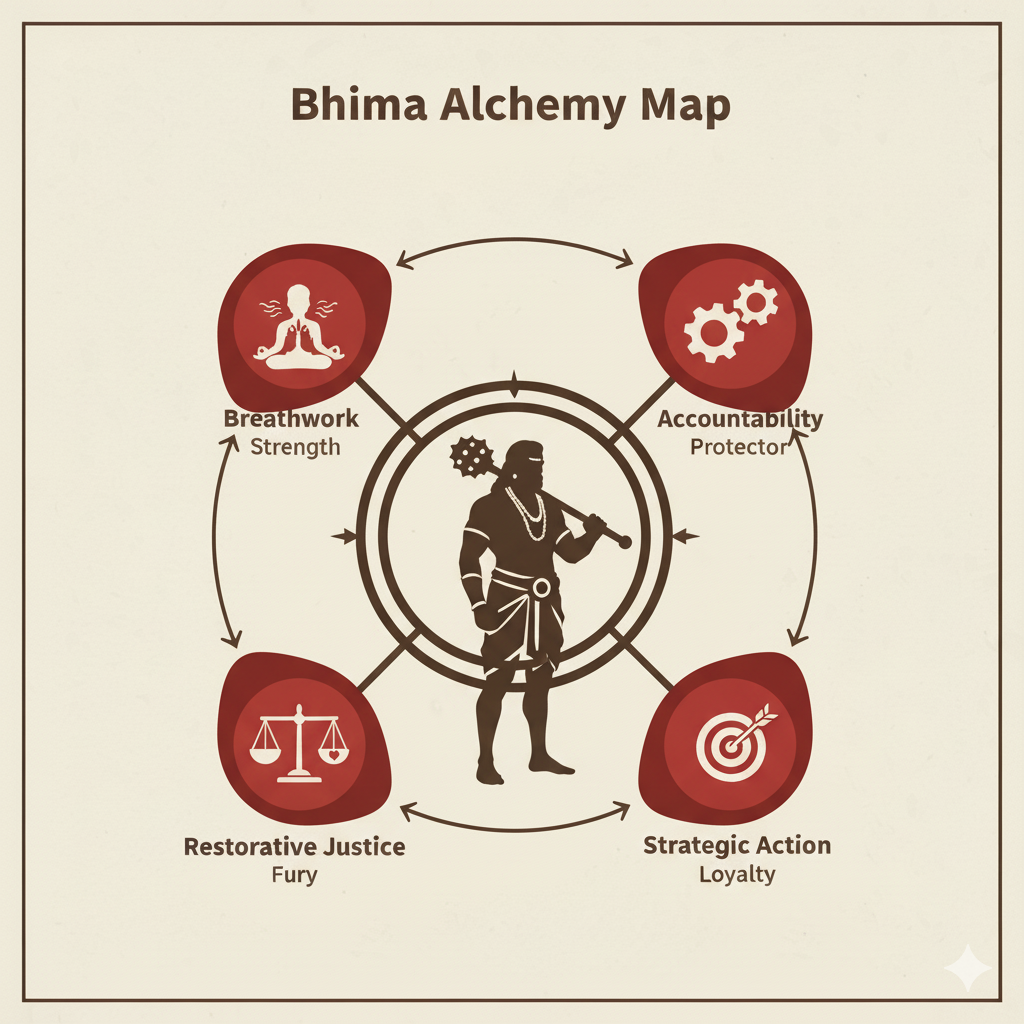
🌟 Why Rituals Work (Brief Neuroethical Note)
Rituals create predictable structure. They recruit cultural authority and cognitive habits. They externalize internal governance. By converting an internal decision into public, social action, rituals make the actor accountable and reward restraint. The Mahabharata’s ancient techniques were not archaic—they were practical social engineering. Modern societies can invent equivalent practices that respect dignity while preventing carnage.
👉 👉 Part V — Leadership Lessons: When Strength Is the Tool — and When It’s the Trap
👉 Bhima as Leader: Protective, Decisive, Flawed
If we read Bhima as a leader, several paradoxes emerge. He protects without always negotiating; he sacrifices himself for family but sometimes ignores counsel; he is decisive, which is a virtue in crisis, but decisiveness without deliberation becomes danger. This tension maps directly onto modern leadership dilemmas: crisis requires bold action; systems require patience.
Bhima offers three distilled leadership principles—each a practice and a warning.
👉 1. Protective Courage — Strength to Safeguard the Vulnerable
What it looks like: A leader who places the helpless first; who will stand in the breach to ensure people can live and speak. Bhima’s interventions—like rescuing Sairandhri—are paradigmatic of protective courage.
How to operationalize: Embed protection as a metric. In organizations, create KPIs that measure how well vulnerable stakeholders (junior staff, customers, marginalized members) are safeguarded. Make “protective courage” a recognized and rewarded behavior.
Warning: Without checks, the protector can become overbearing. Protective acts must be paired with humility and listening.
👉 2. Measured Retaliation — Proportion and Context Matter
What it looks like: A leader who calibrates response to harm, matching remedy to injury without inflaming the conflict. In the Mahabharata, we often see the opposite: proportionality unmoored by passion leads to escalation.
How to operationalize: Institutionalize proportionality via escalation ladders. A conflict should not leap from complaint to public censure without intermediary steps (investigation, mediation, restitution, limited sanction, public closure). Leaders must resist the spectacle of punitive drama.
🏷️ You Might Also Like (Similar Tags)
- Ethical Principles of Wealth Management in Sanatana Dharma
- How the Gita Defines Real Success
- Shiva and the Moon: Exploring Lunar Cycles and Psychological Dynamics
- The Dark Side of Power: Unmasking ‘Never Outshine the Master’ with Vedic Ethics
- Ahimsa Paramo Dharma: Navigating the Sacred Balance of Non-Violence and Duty in Sanatana Dharma
Warning: The temptation to “make an example” is powerful. Spectacle serves short-term image but degrades long-term trust.
👉 3. Humility & Counsel — Let the Circle Temper the Sword
What it looks like: Bhima’s victories are often solitary. When leaders act without counsel, they miss moderating wisdom. Counsel in the epic—Yudhishthira’s restraint, Krishna’s counsel—works as a stabilizer.
How to operationalize: Create formal counsel mechanisms: advisory boards, ethics committees, and counsel circles that leaders commit to consult when stakes are high. Make consultation an explicit part of crisis protocol—no unilateral public action without an ethics sign-off in defined scenarios.
Warning: Counsel should not be a rubber stamp. Mix independence with diversity. Counsel must include dissenting voices empowered to speak and be heard.
👉 Organizational Analogies: From Battlefield to Boardroom
The Mahabharata’s battlefield translates into modern organizational crises. Consider the CEO who becomes the company’s Bhima: decisive, charismatic, quick to protect the firm’s image. Without guardrails, that CEO may act in ways that protect brand but injure employees, customers, or communities.
Analogous structures and practices:
- Crisis Response Teams (CRTs): Like war councils, these teams are cross-functional and trained in measured response. They are activated by defined triggers and operate with pre-agreed protocols.
- Temperament Audits: Evaluate leaders for reactivity risk—how likely are they to go from grievance to public act? Include measures like response latency, past escalation patterns, and tendency to reward spectacle.
- Board Accountability: Boards are the sabha of modern corporations. Their job is not merely oversight of numbers but moral stewardship—ensuring that strategic actions align with values and proportionality.
👉 Actionable Leader Checklist
A checklist translates myth into practice. Leaders can print, pocket, and use it as a real-time guide.
Bhima-Informed Leader Checklist
- Early Warning Signs
- Sharp spikes of personal involvement (a leader personally inserting into a grievance that could be delegated).
- Immediate language of absolute moral certainty (“This is unforgivable”).
- Public statements demanded within hours without counsel.
- Recurrent triggers tied to identity (slights to tribe, community, or self).
- De-escalation Protocols
- Three Breath Pause: Mandatory for public-facing responses.
- 24–72 Hour Cooling Policy: For major decisions that could harm reputations or livelihoods.
- Delegation Clause: If a response is likely to be violent in tone, delegate initial engagement to trained mediators.
- Delegation of Confrontation Tasks
- Assign a “confrontation officer” (internal or external) for high-stakes conflicts. This person is trained in proportional response and restorative practices.
- Use this officer to bridge between claimant and institution before escalation to punishment.
- Restorative Checkpoints
- Is the primary objective repair (restoration) or retribution (punishment)? If the latter, is there a wider system to justify it?
- Have we invited the affected parties into a restoration process with clear restitution steps?
- Post-Action Audit
- After any significant action, convene a post-mortem: what harms were created? Who suffered collateral damage? What reparations are necessary? Publish findings where appropriate.
👉 “When institutions reward spectacle, Bhima’s roar becomes the accepted norm.”
Spectacle is seductive. Spectacle sells narratives of strength and decisiveness. But spectacle mutates incentives: leaders become performers; institutions become audiences. The Mahabharata warns us that when spectacle wins applause, moral architecture erodes. Modern organizations must therefore realign incentives: reward measured containment and repair as loudly as bold blows. Make the quiet work visible: publish restorative outcomes, elevate mediators, and celebrate restraint.
🌟 A Short Case Template: Fictionalized Modern Bhima (for Editors & Trainers)
To make these lessons operational for trainers and writers, use a fictional yet realistic case study template that avoids naming real persons but maps to likely scenarios.
Case Title: The CEO Who Roared
Setting: Tech company, mass layoff rumor, leaked internal memo that shames a team publicly.
Bhima Moment: CEO issues an immediate public reprimand and fires the head of the team in a dramatic fashion.
Consequences: Morale plummets, resignations spike, media frames the company as punitive.
Restorative Path: CEO owns the misstep in a public letter, initiates a review, partners with an independent mediator, offers reparations, and creates a new policy for grievance handling.
Learning Points: The spectacle solved one problem (public image control) but created deeper systemic harm. The restorative path prioritized repair and long-term trust.
Use this template in leadership workshops to simulate decision points, test escalation ladders, and practice the checklist. Fictionalization preserves ethical safety while delivering the psychological realism leaders must train against.
👉 👉 Reflection
Bhima teaches us that strength is neither villain nor saint; it is a raw element that can be forged. Dharma asks for discernment; rituals give us tools; leadership studies show how to embed containment into institutions. Across these sections we have built an ethic of measured valor—a world where protective courage is prized, but not at the cost of proportionality, humility, or repair.
The Mahabharata’s unresolved tensions are not failures but invitations. It invites modern readers—leaders, citizens, and communities—to design architectures that let rightful force be used without celebrating the rage that births it. The three practical offerings—the accountability lens, the containment ritual, and the leadership checklist—are small scaffolds. They do not eliminate fury (nor should they), but they convert it from a cliff-edge leap into a disciplined path where strength can become stewardship.
👉 👉 Part VI — Case Studies: Modern Bhimas (Fictionalized + Real-world Templates)
👉 Why cases matter
History teaches us patterns; cases teach us how patterns show up today. Below are three condensed portraits—each a mix of real-world texture and fictional composite—designed to reveal a particular Bhima-pattern: righteous energy that either rebuilds commons or unintentionally destroys them. For each case I name the problem, isolate the Bhima-pattern, outline interventions tried, and note outcomes and learning points. These are practical templates editors, trainers, and community leaders can adapt.
👉 Case 1 — The Activist Who Burned Bridges
Problem. A charismatic community organizer named Meera (composite) campaigns to stop an environmentally destructive project in a rural watershed. Her fiery speeches and uncompromising public tactics rally many volunteers, provoke media attention, and force officials into temporary concessions. But as protests escalate, she attacks ally NGOs for “compromise,” outbids coalition partners in headline stunts, and publicly shames moderates on social media. Long-time allies feel alienated; funders withdraw; policy windows close as officials dig in.
Bhima-pattern identified. Protective courage + low containment. Meera acts from a righteous protectiveness—her energy is catalytic—but lacks ritualized pause and inclusive counsel. Her strength becomes a broadcasted roar that crowds out coalition-building.
Intervention. A small group of elders and former movement leaders invite Meera into a counsel circle (modeled on restorative practice). They propose a containment ritual: a public “campaign covenant” that commits all coalition members to deliberative pauses before major public actions, and creates a rotating “liaison” role to represent coalition decisions. Meera agrees to a 72-hour cooling clause for any action with legal consequences.
Outcome. The movement stabilizes; media tactics become surgical rather than theatrical. Meera retains moral authority but learns to share stage space; allies return. The policy process reopens and eventually yields a negotiated protection zone rather than a rushed and fragile victory. Long-term: the campaign’s stewardship structures outlast Meera’s tenure, preventing the movement’s collapse when she steps back.
Learning thread. Structure channels strength. Without shared governance rituals, charismatic force cannibalizes its own cause.
👉 Case 2 — The COO Who Broke Teams (and Tried to Repair Them)
Problem. Raj (composite), Chief Operating Officer at a fast-growing startup, has a reputation for brutal efficiency. When a product launch fails, he delivers an explosive all-hands chastisement: names, tones, and threats. Productivity briefly spikes, but burnout, covert resignations, and a toxic rumor mill follow. The company loses three senior engineers in a month.
Bhima-pattern identified. Reactive enforcement + lack of restorative aftercare. Raj’s protective instinct (protect the company’s market share) turns punitive. There is no restitution for the human cost.
Intervention. The Board insists Raj attend an executive restorative program. He undergoes a “reparative arc”: public apology, small-group listening sessions, and a structured restitution plan (paid sabbaticals, leadership coaching for affected managers, transparent changes to performance protocols). HR redesigns incident SOPs: any public reprimand now requires a prior private audit and a restorative follow-up.
Outcome. The team gradually rebuilds trust; some employees return; attrition declines. Raj learns to route his immediate impulses through a confrontation officer for the first 18 months and adopts a personal “Three Breath Vow” before public comments. Reputation and culture recover enough to sustain next fundraising round, but the scars remain visible—reminding the company of the cost of sightless fury.
Learning thread. Individual remediation can work, but only when paired with structural change: policies, mediation roles, and transparent restitution.
👉 Case 3 — The Security Doctrine That Inflamed a Region
Problem. A nation-state, responding to an insurgent threat, adopts a hard-line security policy: mass detentions, curfews, and punitive collective fines aimed at discouraging local support for insurgents. The short-term metric—decline in reported attacks—appears positive, but social trust collapses; recruitment to insurgent cells increases; economic networks break; intercommunal resentment becomes entrenched.
Bhima-pattern identified. State-scale protective force without proportionality or repair. The policy is a macro-Bhima: strength deployed as blunt instrument, satisfying immediate safety needs but failing long-term stewardship.
Intervention. International mediators and civil society push for a pivot: demilitarized safe zones, truth-and-repair commissions, community policing reform, and economic restitution programs. Local councils (revived and empowered) mediate grievances. The state adopts graduated responses, embeds independent oversight, and funds community-led resilience projects.
Outcome. Incidents decline sustainably only after the state integrates restorative measures—rebuilding markets, compensating civilian harms, and offering civic education. The initial repression left long-standing wounds; the later restorative investments take years to reverse resentment and rebuild cooperative institutions. The society learns the hard lesson: security without repair seeds the next generation’s grievances.
Learning thread. Force without restitution is an unstable equilibrium; sustainable safety requires integrated social repair mechanisms.
🌟 Analytical Thread — Channeling Strength vs. Multiplying Harm
Across these cases the same pattern appears: strength used in isolation—no matter how just its impulse—tends to produce brittle short-term wins and long-term costs. When structure channels strength—through covenants, counsel, restorative sequences, oversight—the same force yields resilient outcomes. The Mahabharata’s repeated moral note is visible: heroic acts matter, but institutions matter more for longevity.

Which Bhima do you recognize in public life today?
👉 👉 Part VII — A Bhima-Inspired Framework for Anger Alchemy
👉 Why a framework?
Bhima gives us the shape of force; contemporary life demands methods to convert that force into durable protection and creative labor. The 7-step B.H.I.M.A. S.T.R.A.T.E.G.Y. below is both mnemonic and operational. Each step is short, replicable, and adaptable to individuals, teams, and public institutions.
🌐 Explore More from AdikkaChannels
- Hydroponics: From Pilot to Profit
- Conscious Deliberation: Reclaiming People, Planet, and Profit from the Manipulation of First Impressions
- Unlocking Free Will: How Neuroscience and Vedic Philosophy Align in the Art of Decision-Making
- Why ‘Thinking’ Alone Fails and ‘No Thinking’ Leads to True Solutions: A Modern and Sanatana Dharma Perspective
- Unmasking the Inner Devil: Harnessing the Subconscious Mind in Sanatana Dharma
- Sanatana Dharma and Secularism: A Journey Through Ancient Philosophy, Inclusivity, and Modern Relevance
- The Hidden Power of Hunger: How Controlling What You Eat and Drink Can Break Your Weaknesses and Bring Self-Mastery
- Wolf Behavior in Sanatana Dharma: Debunking Myths and Understanding True Ethical Principles
- Ethical Principles of Wealth Management in Sanatana Dharma
- In the Stillness of Waiting: Unveiling the Profound Wisdom of Patience in Sanatana Dharma
- Beyond the Vedas: Exploring the Secrets of Shiva’s Pre-Vedic Existence
- Ahimsa Paramo Dharma: Navigating the Sacred Balance of Non-Violence and Duty in Sanatana Dharma
- Mahadev’s Divine Intervention: Unraveling His Role in the Epic Ramayana
- The Mystical Aspects of Mahadev’s Worship: Esoteric Practices
- The Importance of Artha in Sanatana Dharma
👉 B.H.I.M.A. S.T.R.A.T.E.G.Y. — Full expansion & practice
B — Breathe (3:6 reset).
What. Immediate physiological reset: inhale for 3 seconds, exhale for 6 (or three slow diaphragmatic breaths).
Why. Breath immediately down-regulates sympathetic arousal, reduces cortisol spikes, and creates attentional space.
Practice. Keep the Three Breath Vow as a pre-commitment. Use a desktop sticker or phone widget: before any public message, social post, or escalatory call—pause, breathe, name.
H — Honor the Trigger.
What. Name the hurt without weaponizing it. “I feel humiliated” instead of “They are evil.”
Why. Naming reduces fusion with identity and allows the feeling to be examined rather than acted on blindly.
Practice. A 30-second journaling prompt: “Today I felt ___. This echoes ___ (earlier wound).”
I — Invite Counsel.
What. Seek a trusted mirror—counsel circle, advisor, or accountability partner—before acting.
Why. Counsel inserts external perspective and reduces narrative inflation.
Practice. Maintain a short list of 2–3 counsel contacts and an agreed process: “I will call within 24 hours if I’m about to escalate.”
M — Measure Proportionality.
What. Ask: How does the response scale to the harm? Would this action cause more harm than the original offense?
Why. Proportionality prevents cycles.
Practice. Use a 4-point scale (Complaint→Mediation→Sanction→Public Exclusion). Default to lower rungs; escalate only with documented justification.
A — Align with Purpose.
What. Check motive: protection (defend others) vs. ego (punish for self-affirmation).
Why. Purpose clarifies ethical calculus and future accountability.
Practice. Ask two questions: “Who benefits?” and “What will this cost?” Write both answers before action.
S — Story-check.
What. Inspect narrative inflation: are you turning an incident into an epic of personal destiny?
Why. Stories magnify emotion and justify extremes.
Practice. Reframe the story in one sentence from a neutral observer. If dramatic language persists, delay action.
T — Transform (energy conversion).
What. Convert rage into constructive channels—advocacy, repair, policy design, creative work, physical training.
Why. Energy requires outlet; ethical transformation yields social goods.
Practice. Have three pre-defined constructive options tied to common triggers (e.g., channel humiliation into a public policy brief, a restorative dialogue, or a community art piece).
R — Restitution (commit to repair).
What. Make repair the default end-goal of any intervention.
Why. Restitution rebuilds trust and reduces revenge cycles.
Practice. A restitution checklist: apology, material reparations (if needed), public commitments, and monitoring.
A — Agreements (public accountability).
What. Convert personal promises into shared covenants.
Why. Public naming increases follow-through and invites external checks.
Practice. Publish a short covenant for teams or community groups and renew it yearly.
T — Timebox (cooling & review).
What. Use structured cooling periods (24–72 hours) for non-immediate threats.
Why. Time reduces impulsivity and surfaces new options.
Practice. Mandate timebox thresholds in team SOPs: any sanction beyond X must have a 72-hour review.
E — Enact training (muscle memory).
What. Build skills through rehearsals—roleplay, breath training, mock counsel sessions.
Why. Habits beat intentions under pressure.
Practice. Weekly micro-training (10–15 minutes) for teams: two breath cycles, one roleplay, one debrief.
G — Governance (institutionalize).
What. Make policies and structures that embed these steps into organizational life.
Why. Systems outlive individuals.
Practice. Draft SOPs for heated incidents, create a “confrontation officer” role, and publish restorative metrics in annual reports.
Y — Yield (practice humility).
What. Acknowledge limits; cede space where others must lead.
Why. Yielding preserves communities and prevents monopolies of force.
Practice. Practice rotating leadership in high-stakes responses; make stepping back as honored as stepping forward.
👉 Tools & Practical
Script: “I’m angry but I won’t harm”
- Template: “I am angry about [specific act]. I need 48 hours to consult with my counsel circle before I decide how to respond. My immediate aim is repair, not revenge. I will propose a plan by [date].”
- Use: Public statements, internal communications, social posts. Signals restraint and invites trust.
Mediation guide (short):
- Step 1: Private listening (no interruptions, 10 min each).
- Step 2: Reflecting back (each summarizes what they heard).
- Step 3: Generate restitution options (3 concrete, measurable steps).
- Step 4: Draft a closure statement and assign monitoring roles.
Workplace SOP for heated incidents:
- Trigger: Any public call-out, threat of termination, or legal escalation.
- Immediate Step: 3:6 breathing + pause.
- 24-hour Step: Notify HR; call designated mediation officer.
- 72-hour Step: Counsel circle convenes and submits recommended proportional action.
- Post-action Step: Public closure and restitution audit within 30 days.
🌟 Micro-practices for Daily Discipline
- Physical training: Short high-intensity intervals (15 min) to discharge adrenaline safely.
- Regulated breathwork: Morning 6-minute pranayama (3:6 cycles) as baseline.
- Journaling prompts: “What triggered me today?” + “What story did I tell myself?” + “One constructive thing I can build from this feeling.”
- Accountability partner: Weekly check-ins; immediate text if a public escalation is contemplated.
Practical deliverable idea: Downloadable “Bhima Anger Audit” — a PDF worksheet that walks the user through a checklist: trigger mapping, proportionality scale, counsel list, restitution plan, public naming template, and a 30-day review calendar.
👉 👉 Part VIII — Systems, Policy & Culture: Preventing Bhima-Scale Harm
👉 Macro levers: Institutions that restrain the roar
Individual discipline matters—but without system design, personal change is fragile. Below are systemic levers that reduce the probability of destructive eruptions and align incentives toward restraint and repair.
1. HR Policies that combine safety and restoration
- Clear conduct standards: Define violent, harassing, or coercive behaviors with transparent consequences.
- Restorative pathways: For non-criminal harms, prioritize mediation and restitution before termination when safe and consented to by the harmed party.
- Rapid response & follow-up: When tempers flare publicly, require immediate protective measures (shelter, leaves) and a documented restorative procedure within 30 days.
- Leadership temperament audits: Incorporate behavioral risk assessments in executive reviews and compensation metrics.
2. Media norms that reduce spectacle incentives
- De-prioritize viral outrage: Newsrooms should resist clickbait amplification of rage; add context editors to flag incendiary framing.
- Promote repair narratives: Reward reporting that follows restorative arcs—not only the scandal moment but the restitution arc.
- Platform moderation with grace: Social platforms can route calls for retribution toward mediation resources rather than amplifying mob calls for punishment.
3. Education: emotional literacy + mythic literacy
- Curriculum integration: Teach emotional regulation, conflict resolution, and systems thinking from early schooling. Use mythic stories (Bhima’s story, but also alternatives) as case studies to discuss proportionality, restitution, and the cost of unchecked force.
- Civic training: Teach citizens how to run restorative circles, how to design covenants, and how to evaluate proportional responses.
👉 Structural responsibility: accountability mechanisms & transparent grievance processes
- Independent oversight bodies: In organizations and states, create independent ombuds offices empowered to investigate and recommend restorative solutions.
- Transparent grievance flows: Publicly document how complaints are handled, timelines, and monitoring metrics. Opacity incubates spectacle; transparency creates trust.
- Incentive realignment: Use reward systems to celebrate restraint and the hard work of repair (e.g., “Restorative Leader” awards, inclusion in annual reports).
👉 Cultural valor vs. ethical restraint
Many cultures valorize decisive violence as virtue. Changing that narrative requires both leadership modeling and symbolic practices: public ceremonies honoring those who step back to enable others, festivals that honor repair work, and cultural heroes whose mythology emphasizes restraint over spectacle. Institutions can nudge culture by making ritual space for restitution visible and celebrated.
👉 The ecological angle: why normalized violence corrodes communal resilience
Violence is not merely immediate human suffering; it is an ecological toxin. Repeated cycles of punitive action fracture trust networks that underpin cooperative environmental stewardship. When communities are locked in grievance, collective projects—watershed management, common grazing, forest protection—become impossible. Thus, institutionalized restraint has ecological payoff: it preserves social capital that enables sustainable governance of commons.
If we institutionalize restraint, the planet and people thrive. A culture that trains its citizens to convert fury into repair creates institutions fit to steward long-term ecological projects—those that require trust, patience, and mutual risk-taking.
👉 👉 Part IX — Conclusion: Strength Tempered, World Healed — People, Planet, Profit
👉 The heart of the lesson
Bhima’s life shows that strength is both a gift and a test: the wind-born force that protects can also, if ungoverned, uproot the very soil it meant to defend. Across myth and modern case, one theme recurs: force without form is fragile. The solution is not to blunt strength—strength is necessary—but to marry it to restraint, accountability, and purpose.
Measured valor is the phrase that best captures the ethic we want to cultivate: courage that is deliberate, proportional, and reparative. Whether in households, startups, civic movements, or nation-states, the markers of ethical strength are the same: pause before strike; invite counsel; repair after action; institutionalize checks; celebrate restraint as loudly as spectacle.
👉 A short, memorable pledge (5 lines)
I will name my Bhima.
I will breathe before I strike.
I will scale my response to the harm.
I will repair what I break.
I will yield when yielding preserves the common good.
Readers and leaders can adopt this pledge in teams, councils, and classrooms—print it, sign it, and post it where decisions are made.
👉 People / Planet / Profit — explicit reconciliation
People — healthier relationships, safer communities, moral repair.
When anger is channeled into accountability and repair, social bonds mend rather than fray. Restorative practices reduce recidivism (in behavior and conflict), improve mental health outcomes, and create communities where vulnerability can be expressed without fear of spectacle-driven reprisal.
Planet — cooperative stewardship and fewer cycles of destructive crisis.
When communities are not locked in cycles of suspicion and revenge, they can collaborate on shared ecological challenges—watershed management, community forests, disaster resilience. Violence corrodes the trust necessary for multi-decade environmental projects; restraint protects the social capital those projects require.
Profit — sustainable organizations that minimize reputational risk.
Organizations that harness protective strength ethically retain talent, avoid costly PR crises, and build durable stakeholder trust. Restraint is not soft business—it is strategic risk management. Investors and customers increasingly reward institutions that demonstrate ethical stewardship and effective conflict governance.
👉 Imagine a dawn scene: a field where a single tree once bent to storm now stands because neighbors repaired its roots together. In that practice—pause, counsel, repair—Bhima’s wind becomes a steady breeze that pollinates fruit rather than uproots saplings. The epic image of great strength is not a lone warrior on a battlefield but a communal field held by many hands.
Share one “Bhima moment” from your life or public life—a time when you felt righteous anger—and one concrete thing you will do differently next time. Use the pledge above and sign it in the comments; let the community witness the promise.
Great strength asks a greater question: what will you protect with yours?