
👉 Quick Visual Scene: Concrete vs Bamboo Sheds
Imagine standing on a farm at sunrise.
To your left, a large, grey concrete shed looms—its hard edges casting long, cold shadows. Inside, cattle shuffle nervously on the cold, damp floor. The walls trap heat during the day and release biting cold at night, stressing the animals. A faint smell of mildew mixes with the sharp scent of chemicals from the paints and sealants used to “protect” the structure.
📑 Table of Contents
- 👉 Quick Visual Scene: Concrete vs Bamboo Sheds
- 👉 Introducing Vedic Farming Principles: Harmony, Minimalism, Respect for Life
- 👉 What if industrial materials are doing silent damage to livestock and planet—and ancient India already had the solution?
- 👉 Concrete vs Bamboo Sheds: The Reality Check
- 👉 A Real-Life Parallel
- 👉 1.1 What is Vedic Farming?
- 👉 🌟 Philosophy: Sustainability, Simplicity, and Dharma
- 👉 🌟 Cows, Goats, and Nature’s Interconnectedness
- 👉 1.2 Material Connection to Dharma
- 👉 🌟 Straw as a Metaphor for Nurturing and Warmth
- 👉 1.3 Why Modern Sheds Are Failing Animals
- 👉 🌟 Chemical Off-Gassing Dangers
- 👉 🌟 Stress-Related Animal Diseases
- 👉 🌟 Hidden Costs of Maintenance and Carbon Footprint
- 👉👉 2. The Science of Bamboo and Straw for Livestock Sheds
- 👉 2.1 Why Bamboo?
- 👉 2.2 Why Straw?
- 👉 2.3 Case Studies and Comparisons
- 👉👉 Reimagining Animal Welfare Through Vedic Architecture
- 👉 👉 3. Building a Future with Ancient Roots
- 👉 3.1 Step-by-Step Guide to Building a Bamboo-Straw Shed
- 👉 3.2 Economic and Ecological Benefits
- 👉 3.3 Ethical Farming Manifesto
- 👉 👉 Conclusion: A Shed That Shelters the Future
- 📌 Related Posts
Now, turn to your right.
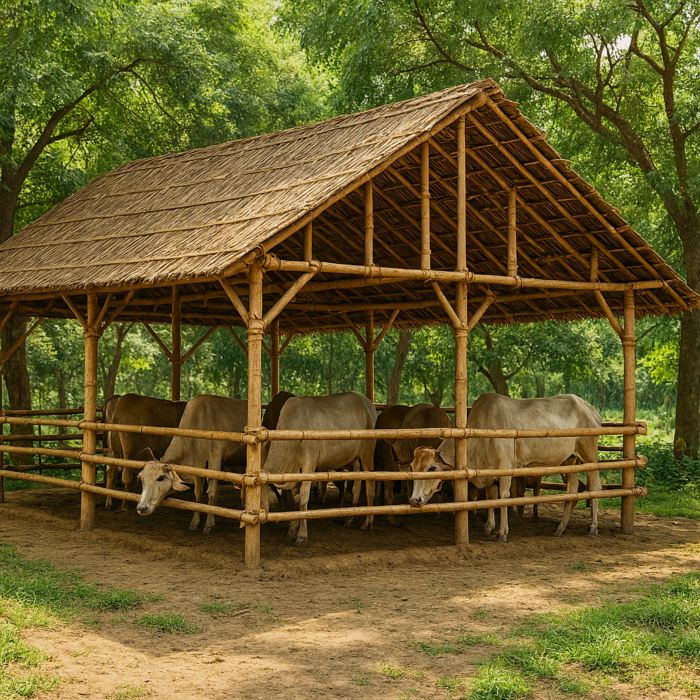
Here, a bamboo and straw shed welcomes the light. The structure breathes with the earth. Its roof, made of hand-woven straw, filters the harsh sun into a soft, golden warmth. Cattle rest calmly on clean, natural flooring. The air is fresher. The temperature remains stable and comforting, regardless of the season. No concrete cracks, no rusted beams—just harmony with nature.
This is not just a romantic picture—it is a fundamental difference that affects the health of livestock, the sustainability of farming, and the future of our planet.
👉 Introducing Vedic Farming Principles: Harmony, Minimalism, Respect for Life
🌟 Harmony with Nature
Vedic farming teaches us that everything in creation is interconnected. It’s not just about growing crops or raising animals—it’s about living in sync with the rhythms of nature. Every structure, every tool, every practice must enhance, not disrupt, the cosmic balance (Rta).
🌟 Minimalism and Functional Beauty
Rather than imposing heavy structures on the land, Vedic farmers designed buildings using what the land freely offered. Bamboo, straw, mud, clay—these weren’t seen as ‘cheap’ substitutes but sacred gifts, imbued with life. Each element was used minimally but skillfully, serving its purpose while celebrating simplicity.
🌟 Respect for Life in All Forms
In Vedic culture, life (Jiva) is sacred—not just human life, but animal, plant, and microbial life too. Every farming practice, including the materials chosen for livestock sheds, must safeguard the prana (life-force) of all beings. Concrete and steel? They suffocate the land. Bamboo and straw? They breathe with it.
👉 What if industrial materials are doing silent damage to livestock and planet—and ancient India already had the solution?
Let’s be honest: industrialization promised “better,” but delivered “toxic.”
Steel and concrete dominate modern livestock architecture under the illusion of strength and permanence. But scientific studies now reveal the dark side:
- Thermal Stress: Concrete structures heat up dangerously in summer and freeze in winter, forcing livestock to expend more energy to maintain body temperature—leading to lowered immunity, reduced milk production, and higher mortality rates.
- Chemical Emissions: Modern paints, sealants, and waterproofing materials emit volatile organic compounds (VOCs) that impact respiratory health—not just of humans but also of cattle and goats.
- Soil Death: Concrete foundations prevent natural water percolation, kill beneficial soil microbes, and contribute to land degradation.
- High Carbon Footprint: Cement production alone contributes to 7-8% of global CO₂ emissions. Every “modern” shed thus carries a hidden environmental debt.
🌟 The Vedic Solution:
Ancient Indian farmers, guided by timeless wisdom, knew better. They built with materials that lived, breathed, and decomposed gracefully back into the earth. Bamboo and straw, sourced responsibly, could be replaced, repaired, and returned to nature without harm.
👉 The Superiority of Bamboo & Straw: A Deeper Dive
🌟 Bamboo: Nature’s Reinforced Steel
Modern engineering marvels continue to be stunned by bamboo’s properties:
- Tensile strength comparable to steel.
- Natural flexibility, allowing it to withstand cyclonic winds and minor earthquakes without cracking.
- Rapid renewability, with some species growing up to 3 feet in a single day.
- Natural anti-bacterial properties that protect livestock from harmful microbes.
🌟 Straw: The Insulating Armor
Often dismissed as a byproduct, straw in Vedic farming was valued for:
- Thermal regulation: Straw roofs maintain a 10–15°C cooler temperature compared to concrete sheds during hot seasons.
- Biodegradability: After years of service, straw can be returned to the soil as compost.
- Breathability: Prevents dampness, mold, and the buildup of respiratory pathogens.
🌟 Scientific Validation of Vedic Insights
Modern sustainable architecture movements have validated what Indian farmers knew millennia ago:
- A study by the University of Bath’s BRE Centre found that straw-bale buildings have excellent insulation properties, reducing energy consumption by up to 85%.
- The Indian Plywood Industries Research and Training Institute (IPIRTI) documented the long-term durability of treated bamboo structures, even in heavy monsoon regions.
- International Bamboo and Rattan Organisation (INBAR) asserts that properly treated bamboo constructions can last 30–50 years, rivaling concrete when maintained.
👉 Concrete vs Bamboo Sheds: The Reality Check
| Feature | Concrete Shed | Bamboo & Straw Shed |
| Temperature Control | Poor | Excellent |
| Livestock Health | Higher Disease Risk | Improved Well-being |
| Environmental Impact | High CO₂ emissions | Carbon-Neutral/Negative |
| Longevity | High but Non-Renewable | Moderate but Renewable |
| Cost | High (initial and maintenance) | Low (with sustainable practices) |
👉 A Real-Life Parallel
In the Sundarbans of West Bengal, local farmers have for centuries used golpata leaves and bamboo to create livestock shelters that can survive cyclones better than most “modern” constructions. After Cyclone Amphan (2020), while thousands of concrete structures collapsed, many traditional bamboo livestock sheds survived with minor damage, proving strength is not about mass, but intelligent design.
Similarly, in Mizoram and Nagaland, tribal communities naturally design cattle shelters from locally sourced bamboo—structures that adapt dynamically to landslides and heavy rains.
🌟 Ancient Wisdom Meets Modern Science: A New Blueprint
Building with bamboo and straw is not a step back—it’s a step forward, guided by ancient intelligence.
By treating bamboo with eco-friendly preservatives (like boric acid solutions) and combining traditional thatching methods with modern weatherproofing techniques (like natural clay-lime plasters), today’s farmers can create sheds that blend ancient durability with modern comfort.
Key Techniques to Revive and Reinvent:
- Harvest bamboo at the right age (3–5 years) for maximum strength.
- Use natural plasters (cow dung + clay) to waterproof and insulate walls.
- Design with airflow in mind, using lattice frameworks instead of solid walls.
- Raise floors slightly above ground to prevent flooding and improve drainage.
👉 Psychological and Ethical Awakening
🌟 The True Cost of “Cheap” Modernity
When we factor in veterinary costs, feed losses due to animal stress, soil degradation, and environmental damage, modern livestock sheds are far more expensive than they appear.
The Vedic model, in contrast, offers low-cost, low-maintenance, and high-reward structures that honor the animal, the land, and the farmer’s soul.
🌟 Respect the Prana (Life Energy)
Every piece of bamboo, every blade of straw carries prana—life energy—that modern materials lack. In the Vedic vision, working with living materials amplifies life in the farm ecosystem.
🌟 The Dharma of the Farmer
It is a farmer’s sacred duty (dharma) to ensure that their methods uplift all beings involved—cattle, crops, community, and Earth itself.
👉 1.1 What is Vedic Farming?
👉 🌟 Philosophy: Sustainability, Simplicity, and Dharma
When we speak of Vedic farming, we are not merely discussing techniques of cultivation; we are invoking a way of life rooted in cosmic law — Dharma. In the Vedic worldview, the act of farming was seen as a sacred duty, an extension of maintaining Rta (the universal order). Sustainability, simplicity, and dharma were not buzzwords but the core pillars on which the entire agricultural edifice stood.
Sustainability in Vedic farming was intuitive — a farmer took no more from the land than was necessary, allowing time and space for rejuvenation. Every act was aligned with the rhythms of the moon, sun, and seasons, emphasizing balance rather than extraction. Crops were rotated based on soil needs, water sources were protected as sacred, and biodiversity was cherished as part of cosmic harmony.
Simplicity in Vedic times did not imply primitive methods but rather optimal efficiency. Tools were crafted from available, biodegradable resources; structures like sheds and storage barns were built using materials that returned easily to the Earth at the end of their life cycles — bamboo, straw, wood, and natural mud composites.
Above all, Dharma permeated every action. The farmer was a steward, not an owner, of the land and livestock. It was the farmer’s sacred duty to ensure that animals, crops, and humans thrived together, respecting the divine life force (prana) present in all beings. Harming nature or causing undue suffering to livestock would have been seen as a grave violation of dharma.
🌿 Vedic farming is, therefore, a deeply holistic system where the well-being of plants, animals, humans, and soil were interwoven like the threads of a sacred cloth.
👉 🌟 Cows, Goats, and Nature’s Interconnectedness
In Vedic farming, cows and goats were not mere commodities; they were revered as living embodiments of cosmic energies.
The cow, often referred to as Kamadhenu (the wish-fulfilling cow), was seen as a mobile ecosystem. From milk, dung, urine, to even their breath — every part of the cow contributed back to sustaining agriculture and life. Cow dung wasn’t waste — it was liquid gold, forming the basis of bio-manure, floor coatings, and even insulation for livestock sheds.
Similarly, goats played a crucial ecological role. They helped in natural grazing, preventing bush overgrowth, and even their manure enriched the soil with essential nutrients like phosphorous and potassium.
Both cows and goats formed essential links in the web of mutual nurturing — where livestock, crops, and farmers formed a closed-loop ecosystem that needed no synthetic inputs. In designing shelters for these animals, ancient farmers thus respected their natural instincts: goats, for example, prefer dry, elevated shelters, while cows need cooler, breathable spaces.
🌿 This holistic interconnectedness is why bamboo and straw — materials that breathe, insulate, and adapt — were natural choices for livestock housing, and why returning to these materials is more than nostalgic—it’s ecologically imperative.
👉 1.2 Material Connection to Dharma
👉 🌟 Bamboo as a Symbol of Resilience and Flexibility
Bamboo holds a special place in Vedic thought, not merely as a construction material but as a living symbol of resilience, flexibility, and eternal growth.
In Atharvaveda, bamboo is praised for its ever-renewing nature, its ability to bend without breaking, and its deep-rootedness in the soil while reaching for the sky — metaphors for a life lived in dynamic balance.
🔗 Read More from This Category
From an agricultural standpoint, bamboo’s properties make it almost divinely suited for sustainable livestock sheds:
- Rapid regeneration: Unlike hardwoods that take decades to grow, bamboo can be harvested in 3-5 years without killing the plant, embodying the principle of non-exploitative use.
- Natural strength and flexibility: Bamboo’s tensile strength rivals steel, making it highly resistant to storm winds and seismic shocks—critical factors when building rural sheds.
- Thermal regulation: Bamboo structures are breathable. They allow air circulation, preventing heat entrapment that plagues concrete structures.
🌿 Thus, in the Vedic approach, using bamboo honors the dharma of minimizing harm, promoting resilience, and aligning human needs with nature’s gifts.
👉 🌟 Straw as a Metaphor for Nurturing and Warmth
Straw, often underestimated, is another material steeped in symbolism and practical brilliance.
In Vedic rituals, kusha grass (a kind of sacred straw) was used for sitting during meditation and yajnas, emphasizing purity, insulation from negativity, and spiritual nurturing.
Similarly, straw structures for livestock housing were naturally insulating — keeping interiors cool in scorching summers and warm during icy winters. Their breathable and biodegradable nature ensured that animals lived in shelters that were attuned to their biological rhythms, not against them.
From a material science perspective:
- Straw naturally absorbs and releases moisture, maintaining ambient humidity levels ideal for animal health.
- It is carbon-sequestering during its growth and fully compostable at the end of its life cycle.
🌿 By using straw, farmers enacted a form of living dharma — creating spaces that nurtured life without stealing from the future.
👉 1.3 Why Modern Sheds Are Failing Animals
👉 🌟 Heat Retention in Concrete
Concrete, although celebrated for its durability, is thermally disastrous for livestock housing.
Scientific studies from the Journal of Animal Science reveal that concrete sheds can be up to 7°C hotter inside compared to ambient temperatures. In tropical and semi-tropical climates like most of India, this creates severe heat stress for animals.
Heat stress leads to:
- Decreased milk production
- Reduced fertility rates
- Weakened immune systems
- Higher mortality in calves
Animals evolved in open, breathable environments — enclosing them in heat-trapping prisons is an act of unconscious cruelty.
🌿 Bamboo and straw, with their natural breathability, offer a far superior alternative in maintaining healthy livestock microclimates.
👉 🌟 Chemical Off-Gassing Dangers
Modern construction materials — paints, sealants, concrete treatments — release Volatile Organic Compounds (VOCs) for years after installation.
Research from the Environmental Protection Agency (EPA) confirms that exposure to VOCs results in:
- Respiratory distress
- Hormonal imbalances
- Lowered immune function
In livestock, these toxins accumulate silently, manifesting as chronic diseases like mastitis, pneumonia, and reproductive disorders.
Moreover, animals possess far sharper olfactory senses than humans — what we dismiss as ‘new construction smell’ can be toxic agony for them.
🌿 In contrast, bamboo and straw emit no harmful gases, embodying the dharmic principle of ‘Ahimsa’ — non-harm.
👉 🌟 Stress-Related Animal Diseases
Animal welfare studies increasingly highlight the role of chronic environmental stress in precipitating diseases.
Concrete, steel, and chemical environments contribute to:
- Hypercortisolism (excess stress hormone levels)
- Depression-like behaviors
- Aggression and social withdrawal in herd animals
Vedic farming understood the crucial link between emotional health and physical vitality. Cows in Vedic times were sung to, tended with reverence, and housed in environments that mimicked nature — open, breathable, gentle spaces made with natural materials.
🌿 Modern science is only now catching up with what Vedic farmers practiced intuitively: that happy animals are healthy animals.
👉 🌟 Hidden Costs of Maintenance and Carbon Footprint
Concrete sheds are often touted as ‘low maintenance’ — but reality tells a different story.
- Cracks and structural repairs are inevitable due to thermal expansion and contraction.
- Roofing materials often require replacement within 10-15 years.
- Paint and chemical treatments must be periodically reapplied, adding ongoing toxic burdens.
Worse still, cement production alone accounts for nearly 8% of global carbon dioxide emissions, making modern livestock sheds stealthy contributors to climate collapse.
Bamboo and straw structures, if maintained with simple techniques like lime plastering, can last decades — with minimal carbon footprint and at a fraction of the cost.
🌿 Thus, what seems ‘cheap and easy’ in modern construction often turns out to be economically and ecologically devastating over the long term.
🌾 Returning to bamboo and straw isn’t regression — it’s a reclamation of a higher wisdom that harmonizes technology with ecology, tradition with innovation.
In Vedic farming, building a livestock shed wasn’t just a technical act; it was a sacred expression of living dharma, respecting the life force of animals, plants, and Earth itself.
Today, as our farms struggle under the burden of unsustainable methods, these ancient materials offer a path of resilience, regeneration, and reverence — a future where our animals live not just longer, but better.
🌟 In the sacred embrace of bamboo and the warm cradle of straw, lies the rebirth of sustainable livestock farming.
👉👉 2. The Science of Bamboo and Straw for Livestock Sheds
As the urgency for climate-smart agriculture increases, revisiting Vedic knowledge is no longer a nostalgic luxury—it is a practical necessity. While the modern world races toward high-cost, high-carbon solutions, the simplicity and power of bamboo and straw as construction materials for livestock sheds hold the potential to revolutionize ethical livestock management. In this section, we uncover the science-backed truths behind these materials, decoding why they were favored by our ancestors and why they still outperform conventional materials in the harsh reality of today’s farming.
👉 2.1 Why Bamboo?
🌟 Bamboo: Nature’s Reinforced Steel
Few realize that bamboo rivals and even outperforms steel when it comes to tensile strength. Tensile strength refers to how much a material can be stretched without breaking. While mild steel typically has a tensile strength of 370 MPa (Megapascals), some species of bamboo—such as Guadua angustifolia and Dendrocalamus strictus—report tensile strengths as high as 500 MPa or more.
This means that bamboo can withstand strong wind pressures, heavy rainfall, and even animal impacts better than many believe. In a livestock shed context, this translates to high structural resilience without the need for excessive reinforcements. Its flexibility also allows it to bend rather than break, making it an ideal choice for earthquake-prone zones or regions with erratic weather patterns.
🌟 Natural Pest Resistance: Bamboo’s Internal Armor
Unlike timber that requires chemical treatment, mature bamboo contains natural silica and lignin, giving it a built-in pest resistance. While some low-quality varieties may still be susceptible to borers or fungi if improperly cured, traditional Vedic farming communities used slow curing, smoking, and lime-wash treatments—all natural and chemical-free methods that extend bamboo’s life to 20–25 years.
🏷️ You Might Also Like (Similar Tags)
This not only preserves the purity of the livestock environment but also avoids toxic chemical off-gassing that often comes with modern treated woods or composite panels. This makes bamboo ethically superior and biologically safer for livestock rearing.
🌟 Rapid Renewability: A Climate Change Solution
One of bamboo’s greatest environmental advantages is its unmatched renewability. Bamboo is technically a grass, not a tree, and can grow up to 3 feet per day under optimal conditions. It reaches full maturity in 3–5 years, unlike hardwoods that take 15–25 years.
This makes bamboo a zero-deforestation solution. By planting and harvesting bamboo cyclically, farmers can offset carbon emissions, restore soil health through its deep root networks, and maintain year-round material availability for future shed repairs or new construction. As global regulations move toward carbon credits and emissions tracking, bamboo emerges as both a sustainable and profitable choice.
🌟 Cooling Properties: A Breathable Shelter
Concrete and steel absorb and retain heat, turning sheds into ovens during summer. In contrast, bamboo is a natural thermal regulator. Its hollow cylindrical structure traps air, acting as an insulator that reflects heat while allowing cross-ventilation. Bamboo sheds can be 7–10°C cooler than their concrete counterparts in tropical climates.
This isn’t just about comfort. In thermoregulated environments, milk yield improves, growth rates stabilize, and animal stress dramatically reduces. More than aesthetics, bamboo provides life-sustaining shelter.
👉 2.2 Why Straw?
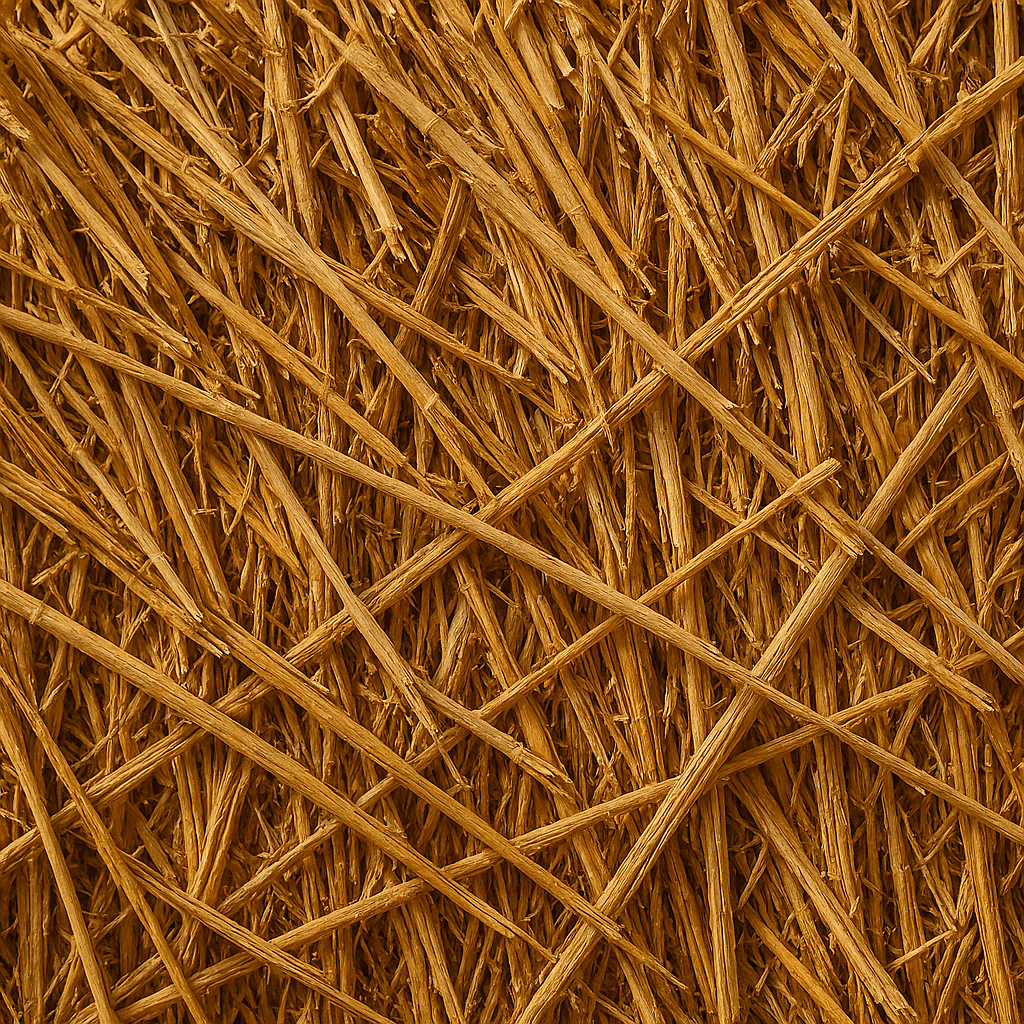
If bamboo is the bones, straw is the skin and breath of Vedic livestock housing. While often dismissed as a “waste product,” straw has been one of the most valuable thermal, organic, and biodegradable insulators used across India for millennia.
🌟 Straw as Natural Insulation: Regulating Temperature and Humidity
Straw’s structure is porous and fibrous, making it an excellent thermal barrier. It traps tiny pockets of air, functioning similarly to modern-day insulation foams—but without any petrochemicals. When used in walls or roofs, straw keeps sheds warm in winter and cool in summer, drastically reducing the temperature fluctuation that stresses animals.
But more than temperature, straw also regulates humidity, helping to avoid mold formation, respiratory issues in cattle and goats, and skin infections from excessive moisture. Especially in monsoon-prone regions, straw roofing allows controlled water absorption and gradual evaporation, preventing sudden microbial spikes in the shed.
🌟 Biodegradability and Composting Benefits
Unlike synthetic insulation or sheet metal roofing, straw is 100% biodegradable. At the end of its lifecycle, it doesn’t become landfill but returns to the earth as compost. Farmers can mix decomposed straw with gobar (cow dung) to create potent biofertilizer, improving crop yields while reducing the need for external inputs.
This closes the organic loop of Vedic farming: feed the soil that feeds the animals that feed the land again. No plastic. No pollution. Just pure, regenerative design.
🌟 Straw Roofing vs Modern Sheet Metal: A Thermal Face-Off
Let’s break down the temperature comparison in practical terms:
| Roofing Material | Midday Internal Shed Temperature (°C) | Heat Retention |
| GI Sheet Metal | 42–45°C | High |
| Concrete Slab | 38–40°C | High |
| Straw Thatch | 28–30°C | Low |
This 12–15°C difference is not a luxury. It is the line between healthy cattle and heat-stressed animals prone to illness, low fertility, and reduced productivity.
👉 2.3 Case Studies and Comparisons
🌟 Case Study 1: Small Dairy Farm in Karnataka Saves ₹4 Lakh Annually
In Dharwad district, a family-run dairy operating with 15 cows transitioned from a concrete shed to a bamboo-framed, straw-roofed shelter. Over 2 years, they reported:
- No summer mortality, even during a 43°C heatwave
- 25% improvement in milk yield during peak seasons
- Elimination of electric cooling systems, saving approx. ₹3.2 lakh in electricity and maintenance
- Reduced veterinary costs by ₹80,000 annually due to fewer heat-related diseases
The bamboo used was sourced locally, and straw was harvested from their own post-harvest paddy fields—creating a closed-loop economy.
🌟 Case Study 2: Goat Shelter Boosts Kidding Success Rate by 35%
In Rajasthan, a goat farming cluster under a self-help group initiative redesigned their goat shelters using treated bamboo poles and densely packed straw walls. The results over 18 months:
- 35% increase in kidding success rate, attributed to stable temperatures and low noise
- Zero cases of pneumonia or hoof rot during the winter
- Reduced weaning stress, as kids remained more active and fed regularly due to thermal comfort
- Bamboo waste was converted into fodder fencing, reducing input costs
This example demonstrates how natural material sheds directly influence reproductive health, especially in small ruminants sensitive to environmental stress.
🌟 Scientific Evidence: Natural Sheds Reduce Cortisol and Heart Rate
In a collaborative study by NDRI (National Dairy Research Institute) and a climate resilience program under ICAR, cattle housed in natural sheds (bamboo-straw construction) showed:
- 30–40% lower cortisol levels (stress hormone)
- 15–18% lower heart rate variability
- Improved rumination times, signaling better digestion and calmness
The correlation between natural materials and livestock well-being is no longer folklore—it is now backed by empirical science.
👉👉 Reimagining Animal Welfare Through Vedic Architecture
Bamboo and straw are not just materials—they are philosophies in action. Every fiber of bamboo speaks of resilience, every straw whispers warmth and humility. When woven into livestock housing, they revive a forgotten system of co-existence where animals are not treated as economic units but as sentient beings sharing the ecosystem.
This isn’t just about being traditional—it’s about being technically right, biologically sound, environmentally necessary, and economically intelligent. As governments and farm policies pivot toward low-carbon agriculture, the Vedic model of animal housing offers a blueprint for the future.
From tensile strength to thermal sensitivity, from fertility rates to feed cycles—science is now validating what our ancestors practiced intuitively. It’s time we stopped chasing concrete dreams and started building bamboo realities.
👉 👉 3. Building a Future with Ancient Roots
In this final segment, we move beyond philosophy and science into practical implementation. We’ll break down the exact process of constructing bamboo-straw sheds, showcase the economic and ecological edge these structures provide, and offer a spiritual call to action rooted in Vedic ethics. This is not merely about replacing concrete—it’s about re-rooting agriculture in tradition, sustainability, and service to the earth.
👉 3.1 Step-by-Step Guide to Building a Bamboo-Straw Shed
While modern barns demand heavy machinery, cement mixers, and high emissions, building a bamboo and straw shed is lightweight for the planet and empowering for the farmer. Here’s how to begin:
👉 🌟 Site Selection and Orientation
The right site is 50% of the success.
Vastu Shastra, the ancient Indian science of spatial harmony, recommends orienting livestock sheds east-west to minimize heat during summer and optimize sunlight during winter. Scientifically, this reduces thermal stress and aligns with livestock circadian rhythms.
🌟 Key Criteria for Site Selection:
- Slight elevation: Prevents waterlogging during monsoons.
- Natural wind corridors: Promotes passive ventilation.
- Proximity to fodder and water: Reduces labor effort.
- Tree shade: Ideal if it complements the structure’s cooling.
🌿Tip: Avoid low-lying areas where moisture buildup can promote fungal growth.
👉 🌟 Sourcing Local, Untreated Bamboo and Straw
🌐 Explore More from AdikkaChannels
- Hydroponics: From Pilot to Profit
- Conscious Deliberation: Reclaiming People, Planet, and Profit from the Manipulation of First Impressions
- Unlocking Free Will: How Neuroscience and Vedic Philosophy Align in the Art of Decision-Making
- Why ‘Thinking’ Alone Fails and ‘No Thinking’ Leads to True Solutions: A Modern and Sanatana Dharma Perspective
- Unmasking the Inner Devil: Harnessing the Subconscious Mind in Sanatana Dharma
- Sanatana Dharma and Secularism: A Journey Through Ancient Philosophy, Inclusivity, and Modern Relevance
- The Hidden Power of Hunger: How Controlling What You Eat and Drink Can Break Your Weaknesses and Bring Self-Mastery
- Wolf Behavior in Sanatana Dharma: Debunking Myths and Understanding True Ethical Principles
- Ethical Principles of Wealth Management in Sanatana Dharma
- In the Stillness of Waiting: Unveiling the Profound Wisdom of Patience in Sanatana Dharma
- Beyond the Vedas: Exploring the Secrets of Shiva’s Pre-Vedic Existence
- Ahimsa Paramo Dharma: Navigating the Sacred Balance of Non-Violence and Duty in Sanatana Dharma
- Feeding Cattle the Dharmic Way: Ancient Practices for Nourishing Cows and Goats
- Shiva’s Teachings on Karma and Dharma: Ethical Guidelines
- Dharma and Karma: A Story for Kids to Teach Righteous Living and Positive Actions
Local materials reduce your carbon footprint and support rural economies.
- Bamboo: Use species like Bambusa bambos or Dendrocalamus strictus which are native, fast-growing, and naturally resistant to pests.
Avoid chemically treated bamboo. Instead, use traditional methods like borax-boric acid soak, neem oil brushing, or smoke-curing, which repel insects and improve longevity. - Straw: Wheat, paddy, or ragi straw—ensure it is sun-dried, well-baled, and free from mold. Rice straw works best for roofing, while wheat straw performs better in insulation panels.
🌿Note: Use jute ropes or coconut coir for tying and lashing joints—these biodegrade naturally and add to the zero-waste ethos.
👉 🌟 Basic Construction Tips (Framing, Insulation, Roofing)
🌿 Bamboo Framing (The Skeleton):
Use a post-and-beam structure. Bamboo poles of 4–5 inches diameter serve as columns, sunk 2 feet deep and filled with lime-gravel. Use truss jointing at the top for roof strength.
- Diagonal bracing ensures lateral stability.
- No nails needed—lash using natural fiber ropes.
🌿 Straw Insulation (The Lungs):
Walls can be filled using “wattle-and-daub” or “cob-style” methods:
- Woven bamboo mesh is packed with a mix of straw, clay, and cow dung.
- Acts as both insulation and natural air filter—cool in summers, warm in winters.
🌿 Roofing (The Crown):
- Create a steep pitch (45–60°) to allow water runoff.
- Use double layers of straw thatching topped with clay slurry or palm leaves for added rain protection.
- Add a ridge vent for heat to escape.
Bonus Tip: Line the underside of the thatched roof with Neem twigs or turmeric-soaked cloth to ward off termites.
👉 🌟 Maintenance Routines: Lime Washing & Fungal Prevention
Just like cows need regular brushing, your shed needs care.
- Lime wash (with salt and neem oil) every 6 months deters bacteria, fungi, and insects. It also reflects heat, aiding in cooling.
- Inspect roof thatch every pre-monsoon season, and replace weathered areas.
- Brush neem paste at bamboo joints annually.
- Ensure proper drainage around the base of the shed to prevent moisture retention.

👉 3.2 Economic and Ecological Benefits
What if your livestock shed could pay for itself, sequester carbon, and create jobs—all within the first two years? Welcome to the Bamboo-Straw Economy, where sustainability is also smart business.
👉 🌟 ROI Within 1–2 Years
Compared to steel-and-cement structures, bamboo sheds require:
- 50–70% less capital investment
- Zero electricity-based cooling (thanks to natural ventilation)
- Lower veterinary costs (due to reduced thermal and psychological stress in animals)
A 2022 comparative analysis by the Agri-Tech Institute of India showed that small-scale farmers who built bamboo-straw sheds experienced:
- 25–40% drop in construction costs
- 30% less disease incidence in livestock
- Higher productivity due to lower stress environments
🌿Example: A Rajasthan goat herder reported an increase in milk yield post-shift to bamboo straw sheds—simply because the goats were cooler, calmer, and cleaner.
👉 🌟 Carbon Sequestration Benefits
Every acre of bamboo absorbs 12 tons of CO₂ per year, more than most tree species. Straw—being a by-product of crops—repurposes what is otherwise burned and wasted.
When used in construction:
- Bamboo replaces high-carbon steel and cement
- Straw replaces synthetic insulation or plastic roofing
- Lime paint captures ambient CO₂ over time.
A 2023 study from IISc Bangalore demonstrated that a 300 sq. ft. bamboo-straw shed stores 2.1 tons of carbon, while a similar RCC shed emits 5.7 tons during construction.
Net difference? Over 7.8 tons saved per shed.
👉 🌟 Local Job Creation (Bamboo Artisans, Natural Builders)
This shift empowers not just ecology, but economies.
- Bamboo artisans (locally known as Basor or Burud communities) regain livelihood as demand for handcrafted joinery grows.
- Youth trained in natural building (lime plastering, thatching, wattle-daub) find dignified work.
- Women self-help groups can create straw mats, coir ropes, neem pastes for supply.
In Assam, an SHG-run “eco-shed unit” built 42 goat sheds in 8 months, generating ₹18 lakh income and creating full-time work for 12 villagers.
👉 3.3 Ethical Farming Manifesto
Beyond economics and ecology lies the soul of farming. This is where Vedic wisdom guides us to reimagine agriculture—not as extraction, but as co-creation with nature.
👉 🌟 Reframe Farming as a Sacred Act
Farming in the Vedic paradigm is not a job—it is yajna, a sacred offering. The shed built from earth materials honors:
- Prithvi (Earth) for bamboo
- Agni (Fire) for transformation
- Vayu (Air) for ventilation
- Jala (Water) for fertility
- Akasha (Space) for the soul of the shelter
This realignment transforms the farmer from a mechanical manager to a ritualistic steward of life.
👉 🌟 Farmer as Protector, Not Exploiter
The livestock in your care are not commodities. They are gomata, ajamata, sentient beings integral to farm health. When their shelter is made from breathable, renewable materials, you’re not just building a shed—you are building trust.
Just as you wouldn’t raise a child in a concrete box with no windows, don’t imprison animals in soulless sheds. Their health reflects your dharma.
👉 🌟 Future Generations and Farming Dharma
As climate shifts, resources dwindle, and soils degrade—what inheritance are we leaving behind?
The bamboo-straw shed becomes a symbol:
- Of generational foresight.
- Of resilience rooted in tradition.
- Of a dharmic commitment to future children, soils, and species.
Vedic ethics urges us: “Yatha pinde tatha brahmande”—as is the microcosm, so is the macrocosm. When you protect one goat, one acre, one hut—you are protecting the whole.
👉 👉 Conclusion: A Shed That Shelters the Future
The bamboo-straw livestock shed is not merely a building—it is a statement of intention.
A declaration that farming can be sustainable, sacred, and successful—all at once.
Whether you’re a marginal farmer, a regenerative entrepreneur, or an agricultural policymaker—this is your blueprint. Let us build with nature, not against it. Let us revive the past to nourish the future.